Diagnosing Low Residual Pressure and Other Failed Hydrant Flow Tests

A hydrant flow test that comes back with unexpectedly low residual pressure can freeze a design, a permit, or a water-supply evaluation overnight. The number looks like a verdict on the distribution system—and sometimes it is—but residual is also the reading most easily ruined by a closed or throttled valve, a restricted or undersized main, neighborhood demand at the wrong hour, a poorly chosen residual hydrant, or a setup error in pitot placement, elevation, or the coefficient used on the outlet.
This article is written for the engineer or manager who inherits the result, not the crew that just opened the hydrant. Residual pressure in an NFPA 291 test is the pressure that remains at the residual hydrant while flow hydrants are discharging. It is the measurement that turns pitot readings into available fire flow—or into fiction. The 20 psi floor is not a formatting preference. Below it, the usual available-flow calculation is no longer the right use of the data, the mains can be stressed or contaminated by low or negative pressure, and the correct field move is to stop, protect the system, and decide whether the test is still valid.
What follows is a recipient-side triage: what residual actually represents, why 20 psi is the critical floor, how to tell a genuine system limitation from a test-setup or calculation artifact, what to do immediately when residual collapses, and how to document a failed or marginal test so the water utility and the authority having jurisdiction can act without stalling the project.
When a Low-Residual Report Lands, Treat It as Intake
That work begins the moment the sheet, PDF, or model extract arrives. You are almost never the person who held the pitot. You are the engineer, reviewer, or utility contact who must decide whether the numbers show a real distribution limit, a test that cannot be used, or a result the authority having jurisdiction will refuse. Treating residual as a failed main is how projects freeze for the wrong reason.
Failure is not a single reading. Residual that breaches the floor the calculation needs is one mode. Available fire flow too low for the occupancy—even if residual stays technically usable—is another. Static and residual pairs that cannot be reconciled with each other, with elevation, or with the hydrants that were supposedly open, are a third. Any of those can draw AHJ rejection even when the crew thought the test was clean.
Confirm the package before you interpret the drop
Before you brief anyone, run intake on the record itself:
- Test date and time versus expected demand (ordinary or peak, nearby flushing or construction)
- Hydrant IDs for residual and flowing hydrants, and which outlets were used
- Gauge calibration notes and confirmation residual was read on a closed hydrant
- Weather, elevation difference, and any correction applied
- An explicit NFPA 291 method statement, not a generic “flow test” label
Gaps or contradictions here are a documentation problem, not proof the main is undersized. Structured triage holds the result, completes the record, and only then assigns the drop to the distribution system or to the test. Replacement, storage, pumps, or a freeze come after that assignment—not instead of it.
Residual Pressure and the 20 psi Floor
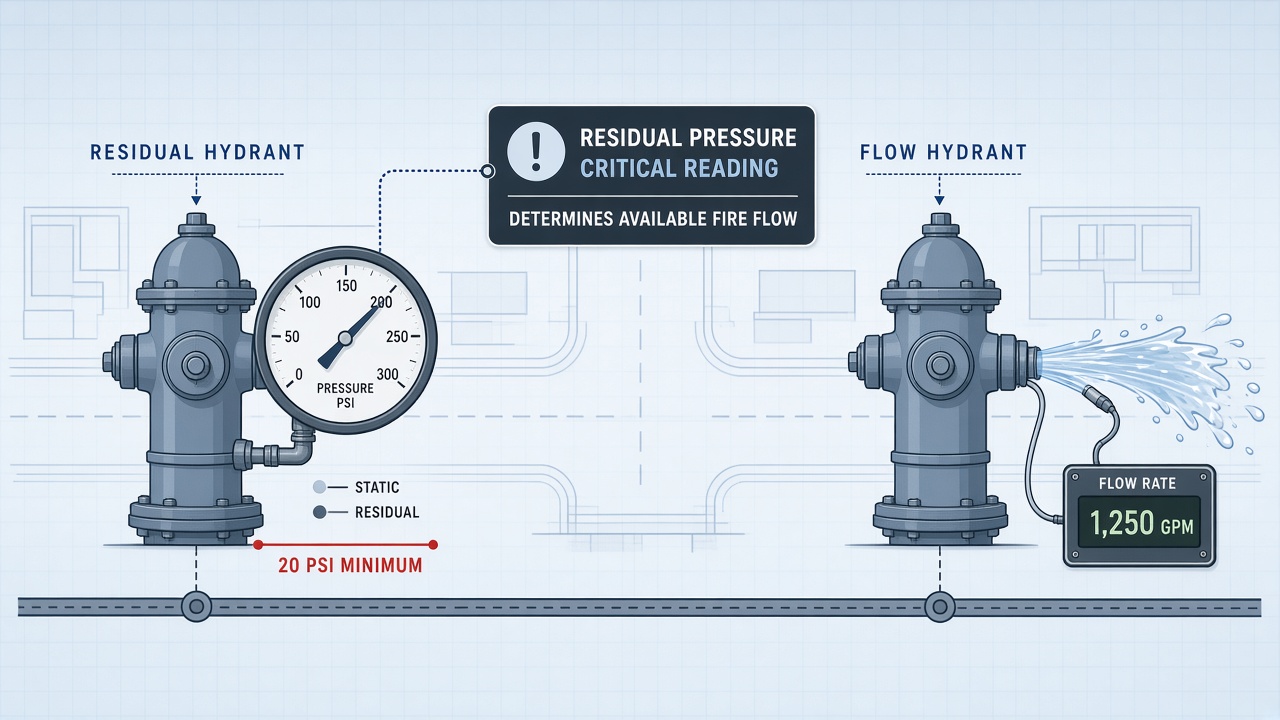
That assignment starts with residual itself. Residual pressure is the pressure remaining on the system at the residual hydrant while flow is discharged from the flow hydrant—not a second static reading taken after the gauges settle. Static is the no-flow condition. Residual is the loaded condition. Confusing the two, or logging residual as “the other gauge,” puts every later call about mains, pumps, or a failed hydrant flow test on the wrong number.
NFPA 291 available-fire-flow practice treats 20 psi residual as the floor because the distribution system must still function while a large fire flow is on. Below that mark, remaining hydrants lose usable outlet pressure, fire-pump suction margins shrink, and you can no longer take distribution integrity as given. Residual at or below 20 psi is therefore a stop-and-triage event: the hydrant flow test has left the range in which you simply report available fire flow and move on.
That same floor is why Q@20—the conversion of observed flow to the 20 psi residual condition that sprinkler supply calculations and ISO-style conversations usually want—fails or becomes severely limited when residual is already near or below the floor. The method assumes you measured a drop above 20 psi and can slide along a well-behaved system curve to that design point. When residual is already there, you are not interpolating; you are at or past it. Running Q@20 anyway overstates what the system can deliver, or it yields a figure that cannot serve as a sprinkler water-supply input. Thin residuals also turn small gauge, elevation, or pitot errors into large Q@20 swings. The observation may still describe a stressed system. It is often not a usable design result.
For engineers and managers the stakes are three separate go/no-go calls, not a single “how close we got.” Is the water supply adequate for the intended fire protection, or do pumps and on-site storage now sit on the table? Is this sheet even a result, or only a residual pressure drop that has not yet been confirmed as system pressure under flow? Can you brief the utility and the AHJ as if available fire flow had been demonstrated? Residual at the floor answers those questions before anyone authorizes a main replacement or a project freeze. Assigning the drop to the distribution system or to the test comes next.
Was the Drop in the Main or in the Test?
That assignment is a desk job. You already hold static, residual, hydrant IDs, and a claimed method. Before you pick a cause, line the sheet up against four comparators: the zone’s usual static, how far residual fell from that baseline, what neighboring hydrants have shown, and whether the run landed in a high-demand window. A modest drop from a healthy static off-peak is not the same finding as a steep drop from an already thin static at peak irrigation.
Four comparators that decide the call
- Compare static to the zone baseline. Low static across several hydrants means residual is riding a weak starting pressure, not a one-outlet surprise.
- Judge the size of the drop. A large collapse from a normal static still needs a system explanation; a small drop that nonetheless sits at the floor may be a test that should not be scored as available fire flow.
- Read neighbors and history. Matching lows on the same main, or a model that already predicted the shortfall, lean toward the pipe.
- Note time of day. Ordinary demand versus a known peak can move residual enough to change the call.
Clues that the distribution system is the problem
- Low static across the zone, not just at the test hydrant
- The same low residual on a later re-test
- Known or suspected closed valves, long dead-ends, or a mismatch with the hydraulic model
Clues that the test itself is the problem
- Only one hydrant looks odd against its neighbors
- Pitot coefficient, outlet size, or gauge calibration does not match the hydrant
- Elevation ignored, the residual hydrant itself flowed, or the wrong outlet used
Re-test when those artifact clues are present or the record is incomplete. Use a different residual hydrant if the first one was flowed, confirm coefficient and elevation, and pick a comparable demand window. Stop blaming the crew when a second, clean NFPA 291 setup reproduces the same static, the same residual drop, and the same neighborhood pattern. That pair of sheets is enough to treat the main and brief the utility and the AHJ on supply—not on field technique.
Where Genuine Low Residual Actually Lives

Once those two sheets agree, stop defending the crew and locate the restriction. A reproduced static, residual, and neighborhood pattern proves the drop is hydraulic—it does not yet say whether a gate is half-shut, a main is tuberculated, or the residual hydrant sits on the wrong feed. Read the static/residual/flow triplet against prior tests and a zone sketch, and the cause usually falls into a few classes a desk reviewer can name before anyone opens a valve box.
Closed and unexercised isolation valves
Closed, partially closed, and long-unexercised isolation valves are a common field cause of genuine low residual. Static often looks ordinary because the residual hydrant still sees the network at rest; residual then collapses as soon as flow needs that path. Spot a steep drop at modest flow on one hydrant or one block, neighbors beyond a known valve still showing usable pairs, and a stretch of “normally open” valves that have not been turned in years. Partial closure is quieter: residual is low but not zero, and the drop does not match the diameter on the drawing.
Tuberculation, sediment, and diameter limits
When those valves are confirmed open, the same steep residual drop under modest flow usually means the pipe is the throttle. Tuberculation and sediment shrink effective diameter; undersized and dead-end mains never had much to spare. Static can still be acceptable—head loss at rest is negligible—while residual falls once flow starts. Look for residual that has worsened across successive tests at similar flow, a small, unlined, or long-run main, and a drop larger than the nominal size would allow. Unlike a wandering valve, this signature is stable on re-test and shared by hydrants on the same stretch.
Demand, hydrant location, and zone hardware
High concurrent demand shows as depressed static before a nozzle opens, then residual worse than off-peak tests of the same hydrants. A hydrant that is not on the feed serving the project connection yields a clean pair that does not describe the site. Pressure-zone boundaries, PRVs, and pump stations create mismatches: residual hydrant on the low side of a PRV, a booster idle during the test, or a sheet that crossed a zone line. Those triplets show static that does not match expected zone pressure, a drop that tracks pump status, or a neighbor in the correct zone that does not agree. Name the class from the triplet and the map before you brief the utility—valve, pipe, demand, location, and zone hardware each imply a different conversation.
When Residual Falls Below 20 psi: Abort, Throttle, or Relocate
Naming the class does not license you to keep flowing. When residual approaches or breaches 20 psi, distribution safety and crew judgment come first. Restore the hydrant; brief the utility only after the sheet is valid or honestly marked failed.
Abort, throttle, or relocate
The field team has three moves. None of them is opening more outlets to chase a larger flow.
- Abort if residual is at or below 20 psi and still falling, if suction or cavitation appears, or if throttling will not hold residual above the floor. Close the flowing outlet, restore the hydrant, and record the last residual and time.
- Reduce flow if residual can be held just above 20 psi by throttling. Capture a clean static/residual pair at that reduced discharge. That pair can support a limited available-fire-flow statement; the below-floor pair cannot.
- Relocate the flowing hydrant only when the residual hydrant is correct for the project but the flowing hydrant sits on the wrong side of a valve, on a dead-end, or off the feed main. Do not shop hydrants to manufacture a better residual.
What the receiving engineer does in parallel
For the engineer who receives the result, residual at or below 20 psi means the available-fire-flow calculation is not valid in the usual NFPA 291 sense. Do not compute or brief Q@20 from that pair. Flag the report as failed or limited and keep it off sprinkler-supply and ISO use until a valid pair exists.
Capture immediately—or demand from the crew—time of the low residual, whether residual was still falling or had leveled, which outlet was flowing, nearby demand, and any valve operations observed. Those five notes decide the next desk move and keep you from briefing a number the test never produced.
Desk Checks That Expose Fake Failures
The desk move those notes support is a red-pen pass through the PDF, not a main-replacement request. Many “failed” hydrant flow tests never need another setup once coefficients, diameters, hydrant roles, and units are checked. You are not teaching pitot technique; you are deciding whether the sheet is weak supply or only looks like a failed network.
Errors that fake low available flow
Available flow is only as good as four inputs. A C-factor that does not match the flowing outlet, an outlet diameter that does not match the nozzle used, a pitot left in the wrong pressure units, or the NFPA 291 Q formula fed residual as if it were velocity pressure will all collapse Q with no extra drop in the main. Reproduce Q from the stated pitot, C, and diameter before treating the result as fact.
Pairs the physics will not allow
Flag residual higher than static, residual equal to static while flow is claimed, or a steep drop with almost no discharge. Swapped hydrant roles—flowing the hydrant labeled residual, or taking residual on the flowing hydrant—create the same fiction, as does a stated Q with no pitot velocity pressure and gauges at different elevations with no correction. Those invent a number, not a distribution problem.
Accept, reject, or re-test from the PDF
Keep the bar short for the engineer or AHJ reviewing the sheet:
- Accept when static and residual are physically possible, hydrant roles and outlets match the sketch, C and diameter reproduce Q, and elevation is handled—even if residual is only modestly above the floor.
- Reject the number, not the water system, when any of those checks fail. Do not brief Q@20 or sprinkler supply from a broken sheet.
- Re-test only after the paperwork is internally consistent, or when that consistent sheet still shows a genuine, repeatable drop.
Honest marginal supply survives this pass: ordinary static, a steep but repeatable drop, correct C and diameter. Paperwork that only looks like a failed network does not. Draw that line before you brief the utility and the AHJ.
Brief the Utility and AHJ Without Stalling the Project
That briefing is a package, not a theory. A one-line “failed hydrant flow test” gives the utility nothing they can act on and gives the AHJ nothing they can stamp. They need the pair you measured, which hydrants carried residual versus flow, when the test ran, the NFPA 291 method you followed, and the specific decision now blocked—sprinkler design, ISO, occupancy, or all three.
What belongs in the first send
- Raw static, residual, and measured discharge—not a lone available-flow figure
- Map IDs for the residual hydrant and the flowing hydrant(s)
- Date, time stamp, and NFPA 291 method reference
- The decision on hold: sprinkler design, ISO, occupancy, or a combination
Keep every ask operational. You are requesting records and a shared window, not assigning fault for a closed valve or a restricted main.
- Confirmation that isolation valves on the test block were exercised and left open
- Nearby SCADA demand for the same test window
- Prior flow history on those hydrants or that stretch
- A joint re-test window on a shared NFPA 291 setup
What the AHJ needs on the record
If the pair is failed or only usable at a throttled flow, say so. Attach the captured static, residual, and discharge. Do not brief an available fire flow you did not measure, and do not present a floor-breach result as Q@20. The file should show a marginal or failed supply with the raw pair—not an optimistic number occupancy later depends on.
Do not freeze the job while that file is open. While the utility pulls SCADA, valve status, and history, parallel-path a model check on the same hydrant IDs, hold a conservative temporary supply assumption for layout, and sketch alternate supply concepts. Investigation and design can share a calendar so occupancy is not hostage to a re-test date.
Fixes, Re-Tests, and Design Workarounds After Confirmed Low Residual

That shared calendar only works if the next moves are specific. Once valve status and history come back, map each confirmed cause to a discrete fix instead of a vague system upgrade.
Match the cause to the work
- Closed or unexercised isolation valves: exercise the feed-path valves, verify they are fully open, and record positions before anyone flows again.
- Sediment or tuberculation that reproduced on a clean setup: flush first; if the drop stays steep at modest flow, plan cleaning or replacement rather than another pitot at the same hydrant.
- Undersized or dead-end mains that are the true project feed: loop or replace on the capital side so the building connection is not left on a restricted stretch.
- Wrong hydrant relative to the site: relocate both the test and the design tap to the main that actually supplies the connection.
Re-test after the work, under conditions that will stick
A re-test is the proof, not the first remedy. Run it after known valve work is finished, during demand that represents ordinary operation for that zone, and with the hydrant IDs, gauge calibration, outlet coefficients, and elevation notes the original sheet needed. Flow a hydrant that represents the project feed and hold residual above 20 psi so the pair can support available-fire-flow use. The result sticks when the setup is NFPA 291-clean and the neighborhood pattern matches the genuine first test—not when a single off-peak reading looks convenient.
If residual still sits at the floor
When a second clean setup still leaves residual at or below 20 psi, the sheet is no longer a test problem. Evaluate a fire pump and on-site storage against the measured pair, hold a conservative supply curve for sprinkler layout, consider phased occupancy if the AHJ will accept it, or pursue an alternate tap on a stronger main. Those steps keep design moving while the utility plans main work.
The package that closes the loop is short: confirmed cause, work completed or requested, the re-test pair with method and hydrant IDs, and a design path that does not invent Q@20 from a below-floor residual. That is what ISO discussion and AHJ review can use—diagnosis converted into a fix, a result that can be trusted, and occupancy that is not waiting on an unmeasured number.