Private Fire Hydrant Testing: NFPA 25 Annual Flows vs. Full NFPA 291 Capacity Tests

Private hydrants on a campus, plant, or shopping center look like municipal hydrants, but the test that keeps them in service under NFPA 25 is not the test that tells an engineer how much water they can deliver. Treating a short annual flush as a capacity rating leaves sprinkler designs, insurance reviews, and emergency planning on unmeasured assumptions.
Each standard answers a different question. NFPA 25 asks whether every private hydrant will open, flow, drain, and stay operable. Methods associated with NFPA 291 ask how much fire flow is available at a residual pressure—static, residual, and pitot readings that produce a number you can hand to an authority having jurisdiction (AHJ), an insurer, or a designer. Mixing those jobs is the most common misconception in private hydrant programs.
This article separates annual operational flows from full capacity tests, explains when private systems still need NFPA 291-style data, and gives facility managers a practical way to set frequency, documentation, water-purveyor coordination, and the link to sprinkler adequacy. Start by naming what each test actually certifies.
The Blind Spot Between Annual ITM Flows and Capacity Proof
Private hydrant programs often collapse two different proofs into one site visit. NFPA 25 keeps each hydrant operable under the ITM program; methods associated with NFPA 291 measure available fire flow. On a private main those answers diverge faster than on a municipal grid—and the file rarely says which question was actually answered.
Facility teams often treat the annual flow as a substitute for rated available flow because both involve “flowing the hydrant.” On a municipal grid that habit is already shaky. On a private loop it fails. Backflow assemblies, on-site pumps, limited interconnection with the purveyor, and the loop itself sit between the street main and the barrel. A short flush can show the hydrant works and nearby pipe is not blocked. It cannot show residual pressure under design demand, pump contribution, or how the network behaves when more than one outlet is open.
Stakeholders rarely share one definition of a “passing” test. The owner wants a completed ITM record. The contractor wants a hydrant that opened and flushed. The authority having jurisdiction may want proof the private supply still matches the original design. Insurers and design engineers want measured numbers for sprinkler hydraulics, occupancy changes, or suspected degradation. Until those purposes are named, an annual flow looks like capacity proof—and it is not.
What an NFPA 25 Annual Flow Actually Certifies

What it is, instead, is a maintenance proof of condition. NFPA 25 hydrant work is built around operability, drainage, and a clear barrel and outlets—not around publishing a gallons-per-minute rating curve for the private main. The annual flow exists so the owner can show that each hydrant still functions as a fire-service appliance.
- The hydrant opens, discharges, and shuts down without binding
- The barrel and outlets are free of obstruction after a short flush
- The barrel drains, and lubrication, marking, and overall condition are acceptable for continued service
Crews typically open the hydrant only long enough to flush rust, sediment, and standing water. That brief discharge demonstrates that the stem, valve, and nozzles work. It does not hold a residual reading on a neighboring hydrant, does not take a pitot measurement at a known outlet, and does not describe how the private loop, backflow assembly, or on-site pump will behave when design demand is on the system. Residual behavior under that demand is simply outside the task.
Marking and ITM logs close the maintenance loop—not the engineering one
After the flow, the hydrant is marked or tagged and the result is filed in the inspection, testing, and maintenance log. Those records are the right handoff for compliance: they show an authority having jurisdiction or an insurer that private hydrants were exercised, flushed, and drained on schedule. They are not water-supply engineering sign-off. Anyone who later needs a flow figure at a stated residual for sprinkler hydraulics, an occupancy change, or suspected degradation still has to run a capacity test—not reread last year’s flow ticket.
What an NFPA 291 Capacity Test Establishes on Private Mains
That capacity test is built around three field measurements, not a longer flush of the same hydrant. Following NFPA 291 methods, crews record static pressure with no hydrants flowing, residual pressure at a watched hydrant while others discharge, and pitot readings at the flowing outlets. Those numbers feed the calculation of available fire flow at a stated residual—the figure a designer, insurer, or AHJ actually needs.
Layout on a private main is part of the answer
On a private system the geometry of the test has to match the question. Site mains, hydrant spacing, dead-end branches, backflow assemblies, and any on-site pump decide which hydrants flow and which one carries the residual gauge. Opening only the hydrant nearest a building can describe local outlet performance and still miss whether the weak link is that hydrant, an undersized private loop, or the purveyor interconnection upstream. Local hydrant questions need nearby flowing outlets and a residual close to the demand; campus or incoming-supply questions need the private main and the city connection actually in the flow path.
What the results can support—and what they cannot replace
Calculated flow at a reference residual is what sprinkler water-supply evaluations, deficiency investigations, and insurance or AHJ packages require. A drop from a prior capacity baseline can flag closed valves, tuberculation, or a failing interconnection in a way an operational flow never will. That still does not retire the NFPA 25 annual cadence. Full NFPA 291 capacity names a measurement method and an engineering purpose—not a substitute for opening, flushing, shutting, draining, and marking each hydrant on schedule. The two tests live on the same private system and answer different questions.
What Puts a Full Capacity Test Back on the Calendar
Those questions do not stay answered for the life of the property. An annual operational flow refreshes the ITM file; it does not refresh residual and pitot numbers, and it cannot invent a baseline if none exists. Capacity testing returns to the calendar when the piping, the occupancy’s water-supply question, or the parties who must accept the results have changed.
When the private system itself has changed
New private mains, hydrant additions, significant repairs, a replaced backflow assembly, a fire-pump change, or a reconfigured loop all alter how water actually arrives at the hydrant. The last static, residual, and pitot set described a different arrangement. Inferring today’s available fire flow from a short flush on the new piping is guesswork. The capacity test has to be laid out on the as-built system.
When the question is design, not just operability
Sprinkler water-supply evaluation, fire-pump necessity questions, and unexplained pressure or flow complaints all require measured capacity—not only ITM flows. A short operational flush does not produce residual under demand. Aging private infrastructure with no recent capacity baseline is the same problem in slower motion: degradation is a hydraulic claim, settled only with numbers. AHJ directives and insurer or ISO-related requests are independent of construction; they still call for a capacity package, not a stack of flush tickets.
A municipal tap does not close the file
Interconnection with a municipal supply does not automatically retire on-site capacity verification. Private piping, valves, and assemblies still control the delivery path between that tap and the hydrant. If those components govern residual at the fire department connection or at the most remote private hydrant, the test still has to be run on the private system.
Put a capacity test on the work order if any of these apply
- Private mains were extended or replaced, hydrants were added, a loop was reconfigured, or a significant repair changed the hydraulic path.
- A backflow preventer or fire pump was added, replaced, or re-set in a way that affects delivery.
- You need numbers for sprinkler water-supply evaluation or to decide whether a fire pump is necessary.
- Pressure or flow complaints cannot be explained from valves, isolation, or a recent ITM flush.
- An AHJ, insurer, or ISO-related review has asked for available fire flow, not only hydrant operability.
- The private system is aging and has no recent static, residual, and pitot baseline.
- The site is interconnected with a municipal main, but private piping still controls residual at the hydrants or fire department connection.
Who Needs Which Record: AHJ, Insurer, Engineer, and Purveyor
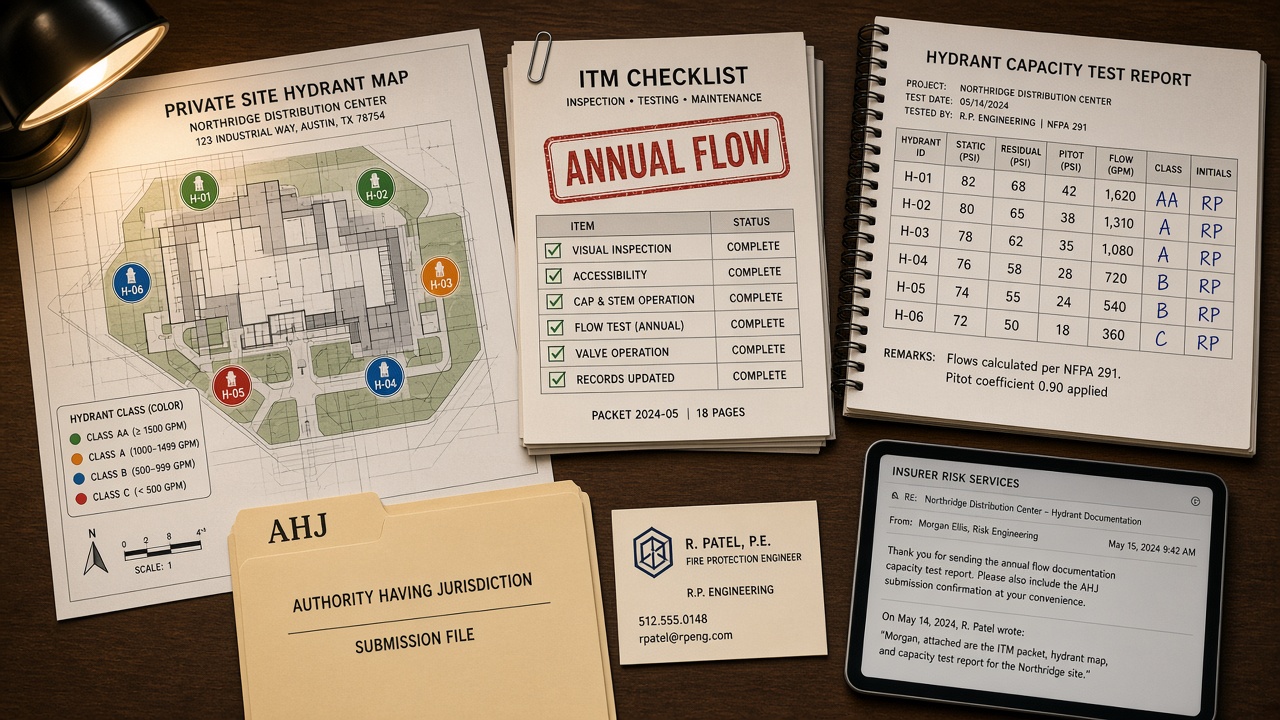
Those same conditions also decide who must receive the results, and in what form. An aging private loop without a recent static, residual, and pitot baseline, or a municipal interconnection that still leaves private piping in control of residual, produces two kinds of paperwork that should never be treated as interchangeable. NFPA 25 records prove inspection, testing, and maintenance were completed: each hydrant opened, flushed, shut down, drained, lubricated, and marked. That log belongs in the occupancy and ITM file. It does not certify available fire flow.
An NFPA 291-style report is the engineering artifact: hydrant IDs, site conditions, measured static and residual pressures, pitot readings, calculated available fire flow at a reference residual, and exceptions when results are weak. Keep the raw field sheets, worksheets, and annotated maps with that report so a later reviewer can reconstruct the test, not just the headline flow.
Matching the artifact to the audience
- AHJ: occupancy and code-compliance evidence—typically the NFPA 25 completion record, plus the capacity report when measured fire flow or a system change is under review.
- Insurer or ISO-related review: the capacity package with hydrant IDs, pressures, flows, and calculations, not a flush log.
- Sprinkler or civil engineer: static, residual, and pitot data tied to the private-main layout so water-supply calculations can be updated.
- Internal risk and facilities: both files, plus maps and a named owner for weak-result exceptions.
On a private site, assign custody of the originals—field sheets, calculated available flow, hydrant maps, and any caveat about inadequate residual—so deficiencies do not vanish between contractors. If the system ties to a water purveyor, document notification, metering and backflow constraints, how discharge was controlled, and any joint-witness expectation. Those notes keep the test defensible when the next reviewer asks who ran it and under what limits.
Liability When Only Operational Flows Are on File
That same defensibility standard cuts the other way. When the only hydrant records on file are NFPA 25 annual flows, the file proves that each hydrant opened, flushed, and shut down—not that the private main can deliver design fire flow at a usable residual. If a fire, insurance claim, or design challenge later tests that implication, the gap is documentary as well as hydraulic: nothing in the ITM log was ever intended to certify available fire flow.
Private hydrants can operate and flush while mains, valves, or supply arrangements still deliver insufficient residual under demand. A closed or throttled valve, a degraded loop, a restrictive backflow assembly, or an undersized interconnection can leave residual pressure too low for the sprinkler design even though every barrel ran clear water. Annual operability does not reveal that condition; only a capacity test with static, residual, and pitot readings does.
Risk rises when marketing, inspection certificates, or internal policies overstate what those ITM flows prove. Language that the water supply is “adequate,” that a flush is a flow rating, or that NFPA 25 completion equals sprinkler-supply sign-off invites a reviewer to treat operational testing as capacity proof. After a loss, that wording is easy to misread as an engineering representation the contractor never made.
Scopes of work should close that door in writing. State whether the engagement is NFPA 25 ITM only, NFPA 291-style capacity testing, or both, and name who interprets results for sprinkler adequacy. Keep certificates limited to the work actually performed. Clear scope language does not replace a capacity test when one is needed, but it keeps operational flows from being asked to carry a claim they cannot support.
Choose, Schedule, and Defend the Right Hydrant Test
That same discipline belongs at the front of the job, not only on the certificate. Before anyone accepts a vendor’s default annual package, name the decision: maintain operability, or prove available supply? NFPA 25 annual flows still have to open, flush, shut down, drain, and mark each private hydrant. They do not become capacity tests because they ran on the same visit. When design, insurance, the AHJ, or suspected degradation needs static, residual, and pitot data, schedule an NFPA 291-style test as its own scoped work.
Let triggers set type, frequency, and urgency
Minimum ITM is not the whole calendar. Use the last capacity baseline, changes to mains, hydrants, backflow, pumps, or loops, and any open external request to choose the test type, any frequency beyond annual ITM, and how soon it must run. A sprinkler water-supply evaluation or unexplained residual drop is urgent. An aging private loop with no recent measured fire flow is due even if last year’s flushes were clean.
Specify the crew, the controls, and the record
Name who is qualified to perform the work, how discharge will be controlled, and whether the purveyor must be notified or present. Operational ITM needs condition and operability notes. Capacity work needs hydrant IDs, site conditions, static, residual, and pitot readings, calculated available flow at the reference residual, a layout map, and weak-result exceptions. State whether an engineer will interpret sprinkler adequacy or the report stops at measured data.
Close the loop on whatever the test finds
- ITM failures drive repair, an operability retest, and an updated maintenance log—not a note that the hydrant “flowed.”
- Capacity shortfalls drive hydraulic evaluation, possible restrictions or improvements, and documented AHJ dialogue. Do not file a weak number in silence.
- Keep named custody of originals so the next request does not force a retest already paid for.
Start from the question, write the scope, and act on the result. Annual flows prove each hydrant still works. Capacity tests prove what the private main can deliver. Both belong on file; only the second certifies available fire flow.