Article library
Articles
Browse all our published articles
0 articles

How to Account for Elevation Differences in Fire Hydrant Flow Tests and Water Supply Evaluations (NFPA 291)
Translate street-level hydrant pressures to design grade with field checks, 0.433 psi/ft math, and supply-curve shifts
Read article
How to Prepare and Use Diffusers and Dechlorinators in Fire Hydrant Flow Testing (NFPA 291)
Keep pitot-based flow numbers valid while you control spray, runoff, and residual chlorine on the flow hydrant
Read article
Phase-Gate Safety Protocol for Fire Hydrant Flow Testing Under NFPA 291
Go/no-go controls, exclusion zones, and stop-work triggers mapped to every stage of the test
Read article
From Field Sheet to Audit File: Documenting and Archiving Fire Hydrant Flow Tests for NFPA 291, ISO & Design
A field-to-office workflow for complete data sheets, evidence packages, retention schedules, and handoffs that survive AHJ and ISO review
Read article
How to Select Residual and Flow Hydrants for Accurate NFPA 291 Flow Tests
A layout-first pairing method so residual and flow hydrants reflect true main capacity—not convenient nearby outlets
Read article
How to Calculate and Apply Friction Loss in Fire Hydrant Flow Tests and Water Supply Evaluations (NFPA 291)
Path-based pressure corrections from the residual hydrant to the design node
Read article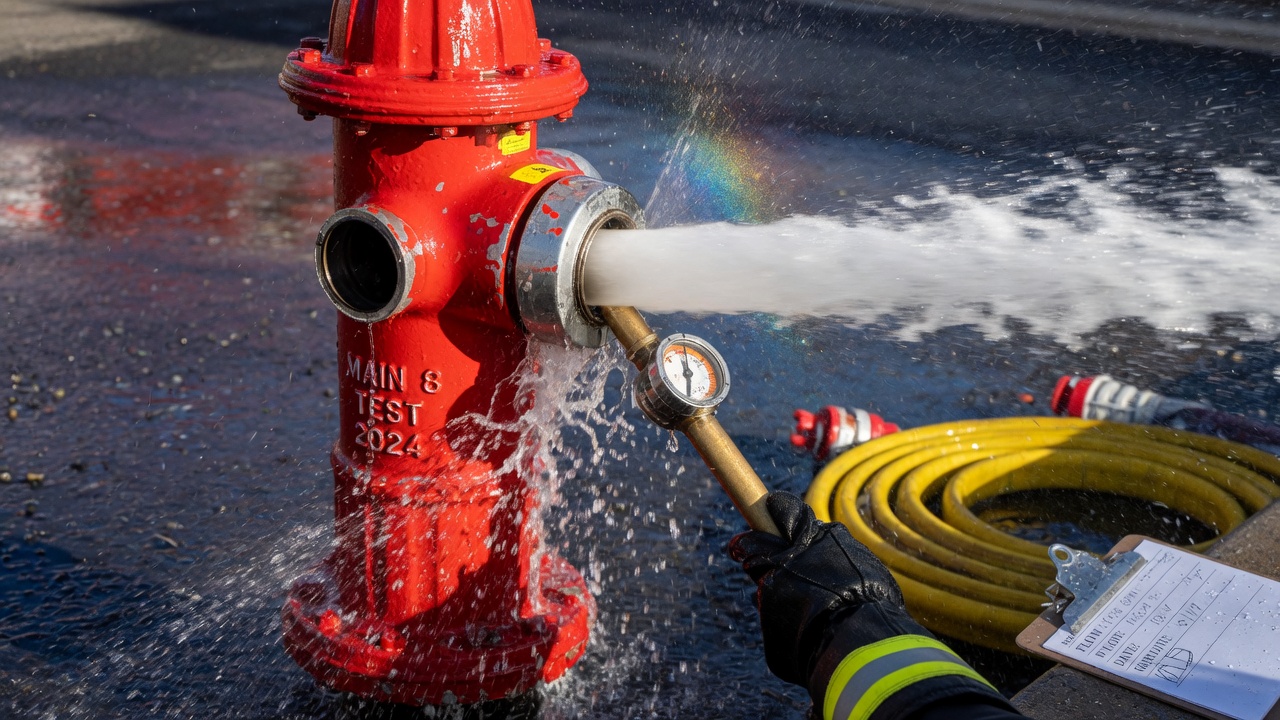
How to Determine and Apply the Correct Discharge Coefficient (C Factor) in Fire Hydrant Flow Tests (NFPA 291)
Field outlet identification, dual-coefficient pumper math, and how C errors scale available fire flow
Read article
How to Calculate Available Fire Flow from Hydrant Test Data: Formulas, Graphs & Worked Examples (NFPA 291)
Cross-check pitot, residual-curve, and rated-capacity paths so your 20 psi AFF holds up in design review
Read article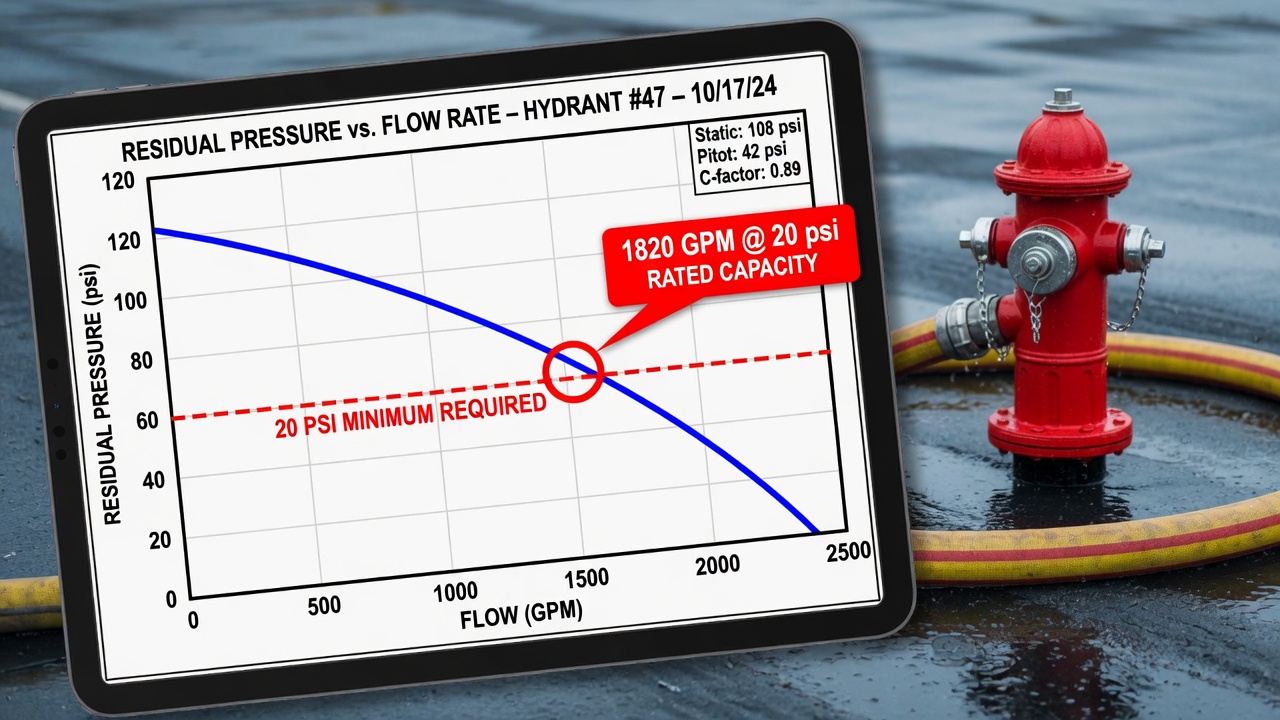
How to Graph and Interpret Fire Hydrant Flow Test Results: Residual Pressure Curves, Available Fire Flow & NFF Calculations (NFPA 291)
Build and read the residual-pressure curve so 20 psi available fire flow and NFF come off the plot—not only from formulas
Read article
How to Measure and Interpret Static, Residual, and Pitot Pressures in Fire Hydrant Flow Tests (NFPA 291)
Turn raw gauge readings into valid capacity data and system diagnostics
Read article
Main Capacity vs. Hydrant Capacity Flow Tests Under NFPA 291: Procedures, Differences & When to Use Each
A use-case decision guide for multi-hydrant supply evaluation versus single-hydrant performance testing
Read article
How Often Should Fire Hydrants Be Flow Tested? NFPA 291, NFPA 25, AWWA M17 & Local Requirements Explained
A public-vs-private frequency decoder that separates annual operational flow from 5-year capacity tests across NFPA, AWWA, ISO, and AHJ rules
Read article
NFPA 291 Fire Hydrant Color Coding and Marking Guide: What the Colors Mean for Flow Capacity
Turn flow-test data into field-ready capacity colors crews can trust at a glance
Read article
Common Mistakes in Fire Hydrant Flow Testing and How to Avoid Them (NFPA 291)
How field errors distort the Q formula, fake available fire flow, and cascade into sprinkler design and ISO failures—with NFPA 291 fixes
Read article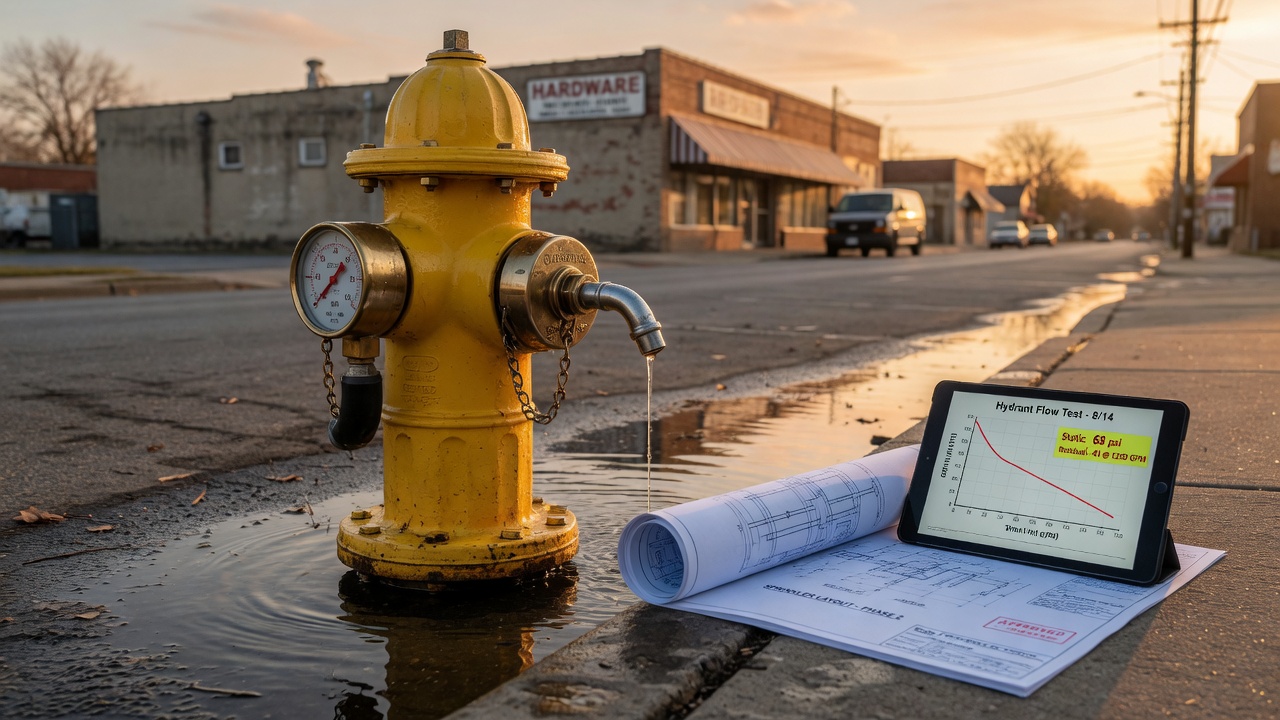
Applying Flow Test Results to Fire Sprinkler Design, Water Supply Evaluation & ISO Ratings
A field-to-desk decision framework: turn hydrant readings into sprinkler go/no-go calls, pump triggers, ISO credit, and AHJ-ready packages
Read article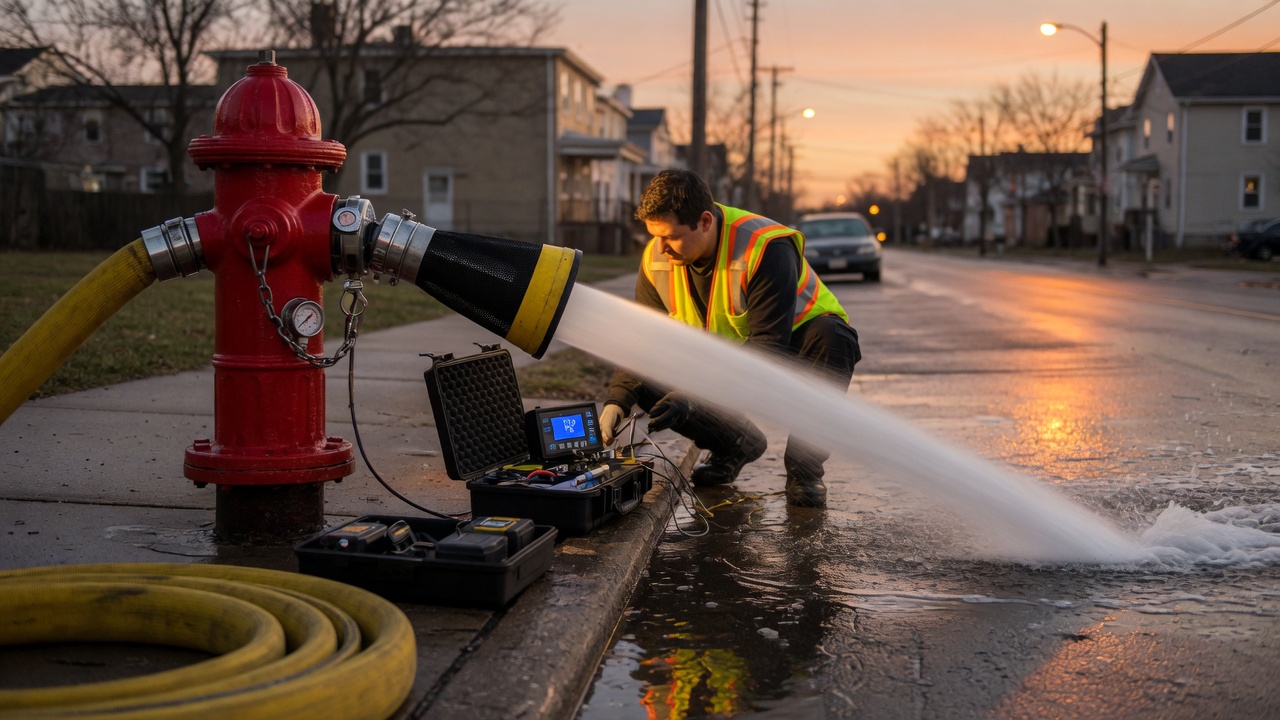
Essential Equipment Guide for Accurate Hydrant Flow Testing: Pitot Gauges, Kits, Diffusers & More
Specify gear by the accuracy chain—not a catalog dump—so every static, residual, and pitot reading holds up
Read article
The Complete Step-by-Step Guide to Conducting a Fire Hydrant Flow Test (NFPA 291)
A field-crew playbook for pairing hydrants, running the live sequence, and marking results to NFPA 291—without getting lost in calculator theory
Read article
Hydrant Flow Test Calculations Explained: Q Formula, Available Fire Flow, Examples & Free Calculator
Convert pitot and residual readings into GPM and rated available fire flow with field-ready formulas
Read articleStay in the loop
New articles, delivered
Get fresh SEO-ready guides when they publish — no spam, just the library.