Phase-Gate Safety Protocol for Fire Hydrant Flow Testing Under NFPA 291
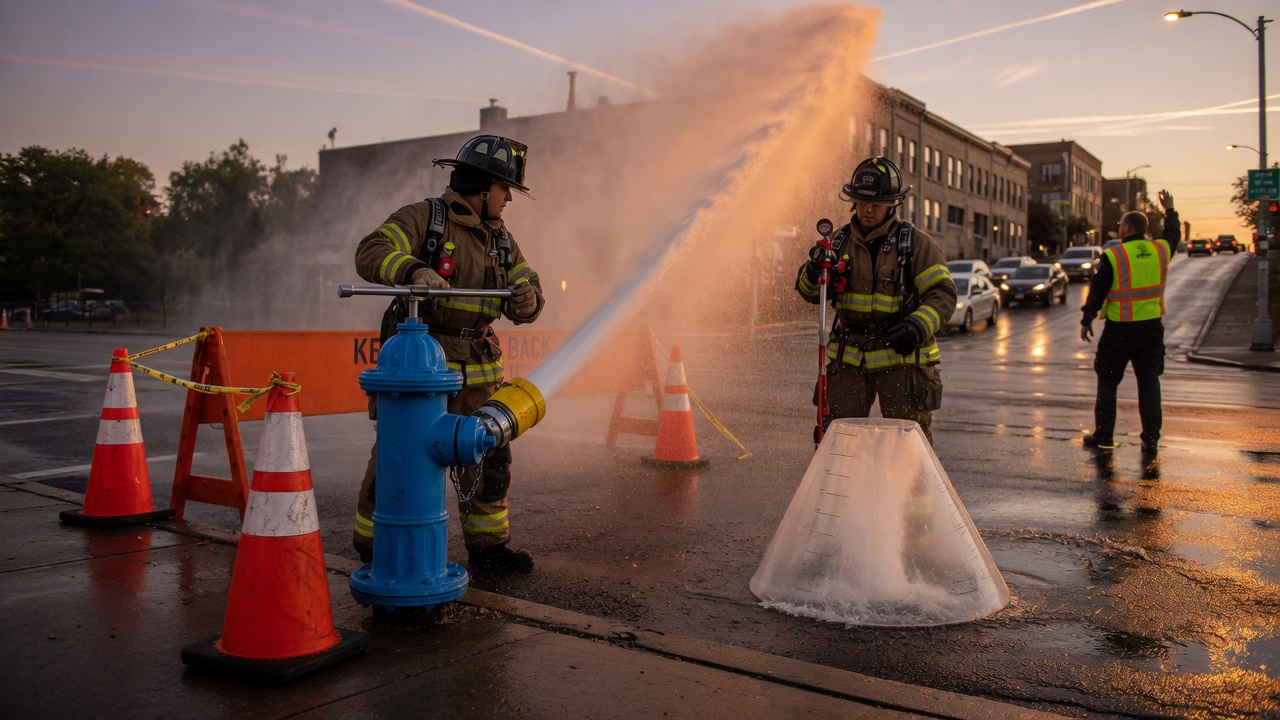
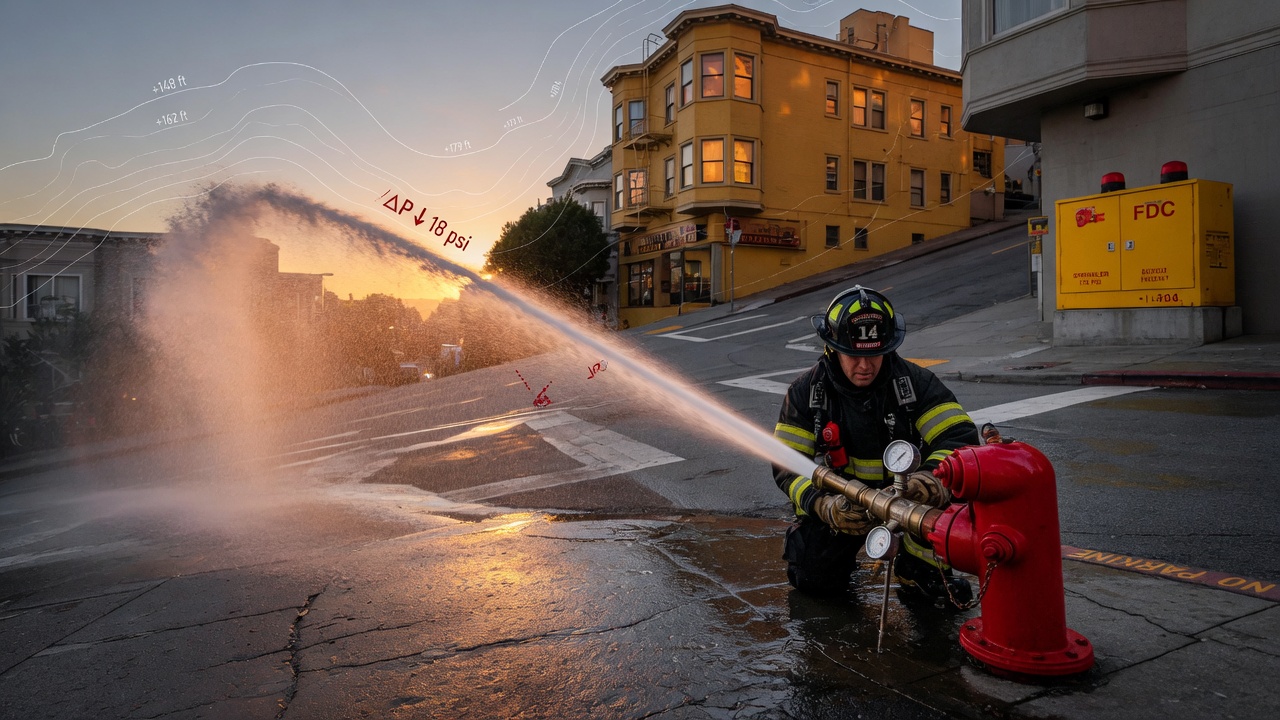
Fire hydrant flow testing under NFPA 291 looks routine until a full-bore stream, a sudden pressure surge, or a wet roadway turns a data collection job into an injury or near-miss. Crews already know the basic kit—helmets, eye protection, gloves, high-visibility clothing, sturdy footwear—yet those items alone do not tell anyone when it is safe to open a hydrant, how far bystanders and traffic must stay back, or which conditions force an immediate stop. The gap is procedural, not equipment-based.
This article treats safety as a sequence of gated decisions mapped to the same phases NFPA 291 uses for residual and flow readings. Each phase gets its own hazard map, go/no-go criteria, exclusion-zone geometry, role assignments, and hard stop-work triggers. You will see how to survey the site and control traffic before any valve turns, how to stage pitot gauges, diffusers, and hoses so the stream stays predictable, how to open and close hydrants slowly enough to limit water hammer, and how to secure the hydrant, clean the area, and document observations after the last reading. The result is a single through-line protocol that keeps measurement quality and crew safety on the same checklist instead of treating them as separate afterthoughts.
Why Phase Gates Outperform Generic Safety Checklists
Phase gates keep safety high while locking out the hazards that appear between the standard’s measurement steps. Generic hazard-and-PPE articles treat risk as a static inventory: high-pressure discharge, traffic exposure, slips on wet pavement, water hammer, and chemical residual. Crews tick the boxes—helmet, eye protection, gloves, high-visibility clothing, sturdy footwear—and then proceed. The trouble is that injuries and near-misses almost never occur during steady-state flow. They cluster at the transitions: when a hydrant is cracked open, when a pitot tube is pushed into a live stream, when valves are closed, or when control is handed off between multiple hydrants.
A phase gate is a named hold point inserted at exactly those moments. Each gate carries explicit go/no-go criteria, a single accountable owner, and a required verbal confirmation before the next energy-releasing action. No one turns a stem, seats a diffuser, or calls for a residual reading until the gate owner confirms the exclusion zone is clear, equipment is stable, and every crew member is in the correct position.
These gates do not rewrite or replace NFPA 291’s measurement sequence. They sit alongside it, supplying disciplined control of pressure energy, public exposure, and crew positioning—the operational details the standard deliberately leaves to local practice. The result is a clean handoff from survey to setup, setup to flow, flow to residual, and residual to secure.
Stop-work authority is pre-delegated to every crew member for a short list of defined triggers:
- traffic breach into the exclusion zone
- unstable or shifting diffuser
- unexpected pressure rise or drop
- loss of visual contact between the pitot operator and the valve operator
Anyone can call the hold. The gate owner then re-verifies the criteria before work resumes. That single rule converts a generic PPE list into a living protocol that catches the high-energy, high-exposure moments generic checklists miss.
Gate 0: Building the Site Envelope Before Caps Come Off
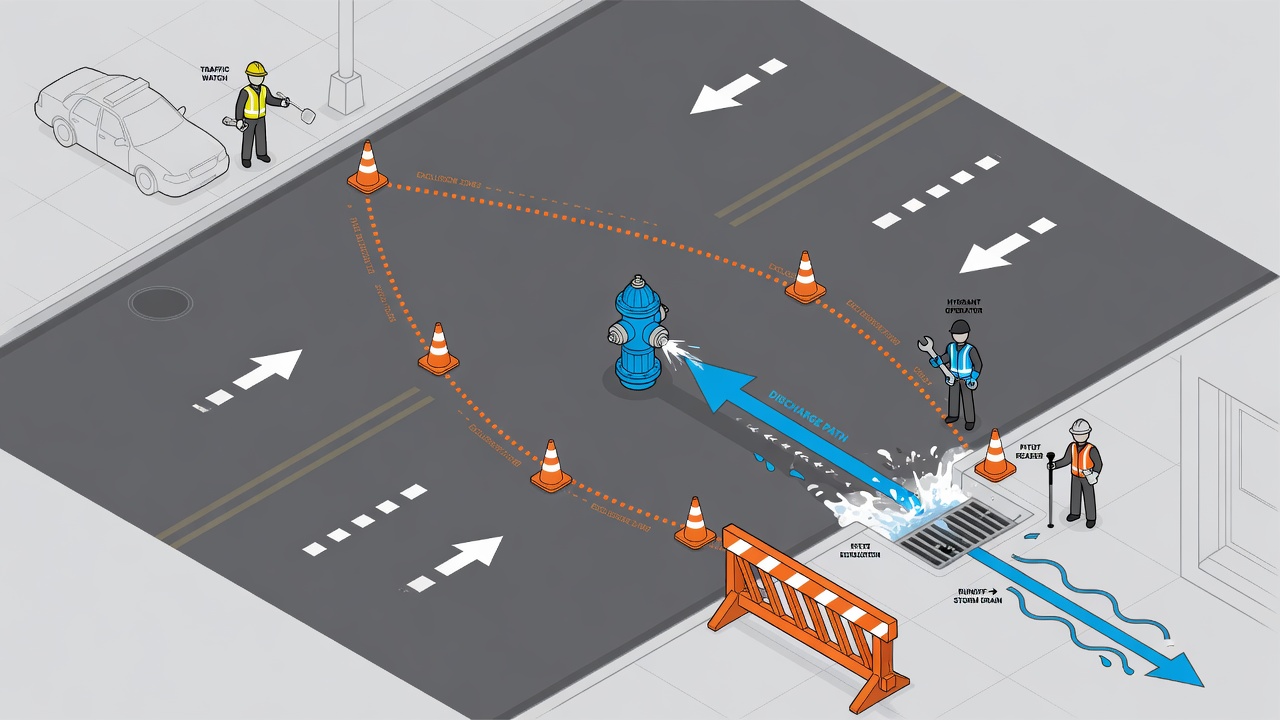
That living-protocol mindset starts at Gate 0—the hold point that must clear before any wrench touches a hydrant cap. The gate owner’s job is simple and non-negotiable: prove that a physical exclusion envelope exists, that it is sized for the real energy of the test, and that every person who might walk, drive, or work near it has been accounted for. Generic checklists stop at “set cones around the hydrant.” Gate 0 demands the envelope be drawn for full-stream throw distance, splash-back radius, and the path a vehicle could take if a driver ignores the first line of barriers. Only when that geometry is marked, staffed, and verbally confirmed does the crew move forward.
A dedicated traffic-and-public watch is assigned at this gate and stays separate from the hydrant operator and the pitot reader. That person owns the perimeter; their sole priority on any breach is an immediate call for valve close. Simultaneously the crew walks the grade, notes every drain and low point, flags electrical equipment or pedestrian routes that uncontrolled water could reach, and locks in diffuser aim plus hose restraint so the stream never leaves the planned corridor. Weather, ice potential, and night or low-visibility conditions are checked against the same envelope: if rain, freeze, or darkness will erase its integrity, the gate stays closed and the test is postponed.
Before the gate owner gives the go, the water utility and any concurrent excavation or street crews are notified so pressure changes and access conflicts are already on their radar. The verbal confirmation at Gate 0 therefore covers five clear go/no-go items:
- Exclusion envelope marked for full throw, splash-back, and vehicle intrusion—not merely the hydrant pad
- Traffic/public watch assigned, radio-checked, and briefed that valve close is the first response to any breach
- Grade, drains, electrical gear, and pedestrian paths assessed; diffuser aim and hose restraint fixed
- Weather, ice, and visibility judged acceptable to hold envelope integrity; postpone criteria agreed
- Utility and nearby work crews notified of timing and pressure interaction risk
Only after every item is affirmed does the gate open. The envelope is now a controlled zone rather than a hopeful circle of cones, and the high-pressure, traffic, and slip hazards that normally appear the moment water moves have already been forced into the open and owned.
Gate 1: Pre-Charge Inspection and Crew Role Lock-In
With the envelope affirmed, Gate 1 holds the crew one deliberate step short of pressure. Nothing is charged, no stem is turned, and no remaining cap is spun until the hydrant, the test gear, and every person’s job have been walked and locked in the open. This is the last clean chance to catch a frozen barrel, a missing restraint, or a role that two people each thought the other owned—before water makes those gaps expensive.
Begin with the hydrant itself. Confirm it opens freely on the planned facing, that caps are present and serviceable, that drains are not packed with debris, and that the barrel shows no cracks, leaks, or other damage that would convert a controlled discharge into an uncontrolled jet. Then verify the kit before any water moves: gauges seated and readable, pitot clean and ready, diffuser intact and rated for the expected stream, and hose restraints staged whenever stream energy warrants them. Unsecured tools, spare caps, and loose fittings stay out of the discharge path—full stop.
Lock every role out loud
Next comes the verbal role lock-in. The crew lead runs a short roll call that names the function and the person who owns it until the test is secure:
- Who turns the operating stem
- Who reads the pitot
- Who watches residual pressure
- Who owns traffic and public watch
- Who records readings and times
- Who may call stop-work—and that answer is everyone
Ambiguity here is a no-go. If two people claim the same task or no one claims traffic, the gate stays closed until the lineup is clean. Stop-work authority remains pre-delegated to every crew member for the same triggers already set at Gate 0—traffic breach, unstable diffuser, unexpected pressure, lost visual contact—plus any new defect found during this inspection.
PPE by exposure, not by habit
PPE is assigned by task exposure rather than a single blanket list. Stream-side positions get impact-rated eye protection and awareness of high-velocity discharge and hearing load. Traffic-side positions wear high-visibility garments that stay readable in wet conditions. Everyone on wet pavement needs footwear with real grip. Gloves and head protection follow the same rule: match the hazard you will actually face once water moves, not a generic “hydrant day” checklist.
Gate 1 opens only when three conditions hold: no role ambiguity, no missing restraint or diffuser when stream energy warrants it, and no unsecured tools or loose gear in the discharge path. When those are affirmed out loud, the crew is ready for controlled open—not because the hazards disappeared, but because ownership of each one is already named.
Gate 2: Controlled Opening, Live Stream Path, and Body Position
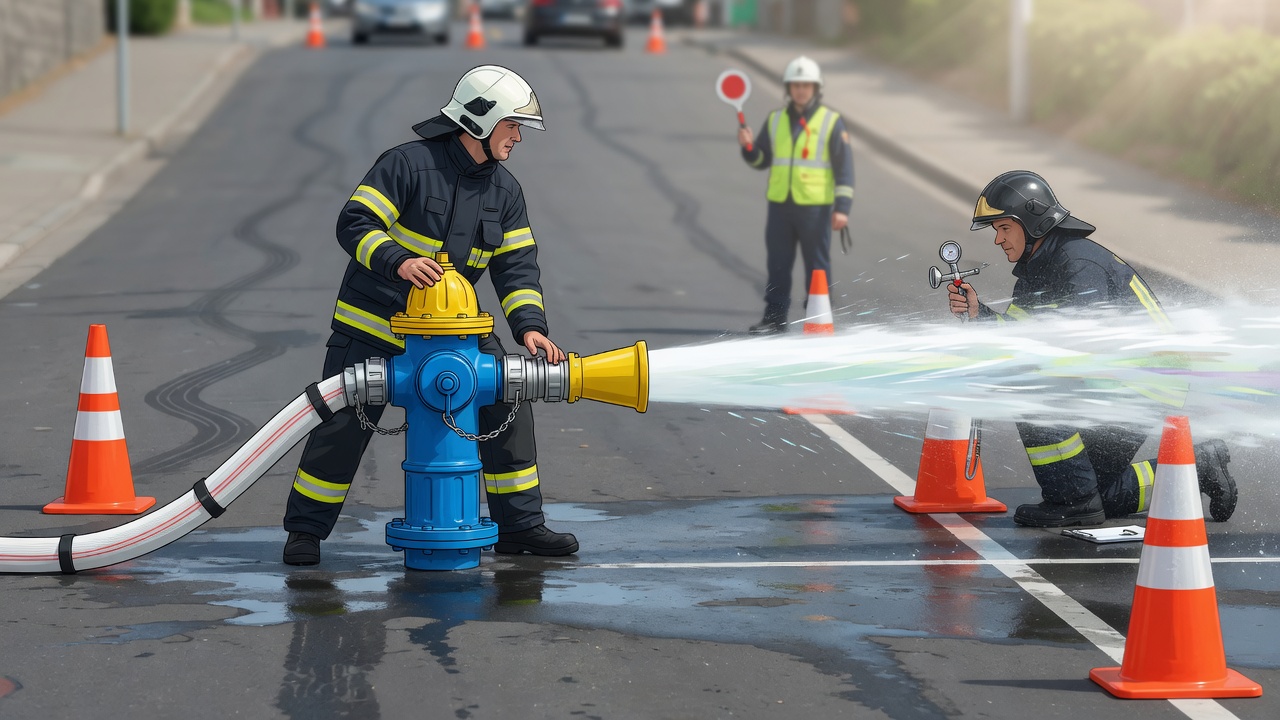
That controlled open is Gate 2. The stem operator cracks the hydrant slowly to a stable intermediate position and holds there long enough for the crew to read the stream, confirm restraints, and re-check the exclusion envelope. No one stands over the operating stem or in line with any cap that could still blow free. Opening is a deliberate ramp, not a full-throw crank, so pressure builds without launching water hammer or an uncontrolled jet.
Treat the discharge path as a live energy line from the first drop. Aim the diffuser or nozzle into the pre-cleared zone, confirm the throw stays inside the envelope, and restrain hose kick before anyone calls for full open. Caps and outlets get the same respect: loosen carefully, control the threads by hand, and keep face and hands out of the potential projectile path. A cap that walks off under residual pressure becomes a blunt projectile; the person who loosened it never stands in its line of flight.
Pitot approach and footing discipline
Once the intermediate stream is stable, the pitot operator approaches from the side—never head-on into the jet. Secure footing on wet pavement comes first; if the surface is slick, sloped, or broken, a dedicated spotter locks eyes on the operator and holds stop-work authority for any slip. The gauge is brought into the vena contracta with a firm two-hand grip; leaning into the stream or planting a knee in the splash zone is forbidden. Gloves and eye protection stay on for the entire reading; high-visibility outerwear keeps the operator visible to the traffic watch.
Gate 2’s go/no-go is spoken aloud before the stem moves past intermediate: stream contained inside the envelope, zone still clear of people and vehicles, hose and diffuser restrained, and every named role still in visual and voice contact. Only then does the stem operator open to the test flow. The gate does not assume the hazards have vanished; it confirms that each one still has an owner watching it in real time.
Gate 3: Locking a Single Channel Across Split Residual and Flow Sites
Once the stream is live and every local hazard still has an owner, many tests move into a multi-hydrant configuration. Main-capacity work almost always splits the crew: one team at the residual gauge site, another at the flow hydrant. That physical separation is where communication failures turn into injuries. Gate 3 is the hold point that refuses to let any stem move until both sites share one plan, one language, and one clear chain of command.
Before the first valve turns under full test conditions, the crew names a primary channel—radio as default, hand signals only when line-of-sight is guaranteed and ambient noise is low. Every open or close command uses read-back language: the sender states the action and the target hydrant; the receiver repeats it verbatim before touching the stem. If contact drops for a pre-agreed interval, flow stops automatically. No one improvises a second channel or assumes the other site “probably heard it.”
Only one person may authorize stem movement at any moment. Conflicting local decisions—one operator cracking a valve while the residual side is still settling, or a traffic watch waving stop while the pitot tech calls for more flow—are a known precursor to lost control of the stream, water hammer, and people stepping into the discharge path. The designated authority stays explicit for the entire flow window; if that person must step away, authority is verbally reassigned before anyone else touches a stem.
Long discharges also bring delayed pressure response and public interference. Residual readings lag; bystanders call in complaints or walk into the wet zone; traffic patterns shift. The traffic/public watch therefore stays active for the full duration, not just the initial setup. The same watch retains immediate valve-close priority if the exclusion envelope is breached.
Go/no-go at Gate 3 is simple and verbal: confirmed two-way link between residual and flow sites, an agreed abort word that every member will act on without debate, and a pre-stated order of who closes first if conditions degrade. When those three items are locked, the test may continue under live flow. When any one of them is missing, the stems stay where they are until the gap is closed.
Gate 4: Controlled Close, Water-Hammer Control, and Abort Triggers
Live flow is only half the work. Gate 4 is the hold point that governs how the crew leaves the flowing condition without converting a successful test into a surge, whip, or struck-by event. The same deliberate pace used to open the hydrant applies in reverse: stem movement is slow, continuous, and watched. Rapid shutoff is a primary driver of water hammer, equipment damage, hose whip, and gauge failure. Residual watchers and stem operators treat close rate as a shared control, not a race to pack up.
Publish abort triggers before anyone opens a stem
Abort criteria are spoken and posted before Gate 2, not invented under pressure. Any of the following stops the test immediately: traffic or public envelope breach, diffuser failure or unrestrained hose, uncontrolled or misdirected stream, crew slip or fall on wet surfaces, unexpected low or high pressure, lost multi-site contact, or public encroachment into the stream path. When an abort is called, the priority order is fixed—protect people first, stop or redirect energy second, then stabilize traffic and notify the utility as needed. Stem motion yields to that order; nobody “finishes the reading” through an active hazard.
On-site emergency card and the close go/no-go
Keep a simple field card at the residual and flow positions: nearest safe muster point, who calls EMS and the utility, and a one-line description of hydrant location that works under stress (street, cross-street, side of roadway, visible landmark). That card removes hesitation when someone is already down or the stream has escaped control.
The Gate 4 go/no-go is explicit: stem movement to leave the flow condition begins only when the exclusion zone is confirmed clear and the residual watcher has acknowledged the intended close rate. If either condition is missing, the stem stays put. Closing under those two confirms keeps water hammer, residual pressure surprises, and traffic re-entry from stacking on top of an already energetic system—and hands the crew a stable hydrant for the final secure-and-clear phase.
Gate 5: Secure the Hydrant, Clear Residual Hazards, and Debrief
That stable hydrant is now the starting point for Gate 5—the final hold before anyone leaves the site. The stem operator confirms the valve is fully closed, then the crew replaces every cap wrench-tight to the local standard, verifies drains are open and functioning, and walks the discharge path for ice, mud, ponding, or any other slip or traffic hazard the stream left behind. Nothing is assumed from the close sequence; each item is checked under the same go/no-go discipline used at every earlier gate.
Cones, signs, and temporary barriers stay in place until that path is no longer a threat. Ownership of the pull-down is assigned by name so the task cannot drift into “someone will get it.” Only after the named owner confirms the surface is clear does the exclusion envelope shrink and the public right-of-way return to normal use.
While equipment is stowed, safety observations ride in the same workflow as the flow readings. Near-misses, any gate that nearly failed, stop-work calls that were used, and equipment defects found in the field are noted beside the residual and pitot data—brief entries, not a separate paperwork exercise. The point is simply that the next crew inherits the lessons without hunting through two different systems.
A short standing debrief closes the protocol: which gate felt weakest, whether stop-work authority was exercised, what gear needs repair or replacement, and one concrete change for the next site. Final clearance belongs to a single named person who walks the restored envelope and states aloud that the public space is clear. When that confirmation is given, the phase-gate sequence ends and the crew leaves knowing high-pressure discharge, traffic exposure, residual slip hazards, and water-hammer risk were controlled at every transition—not merely listed on a generic checklist.