
From Field Sheet to Audit File: Documenting and Archiving Fire Hydrant Flow Tests for NFPA 291, ISO & Design
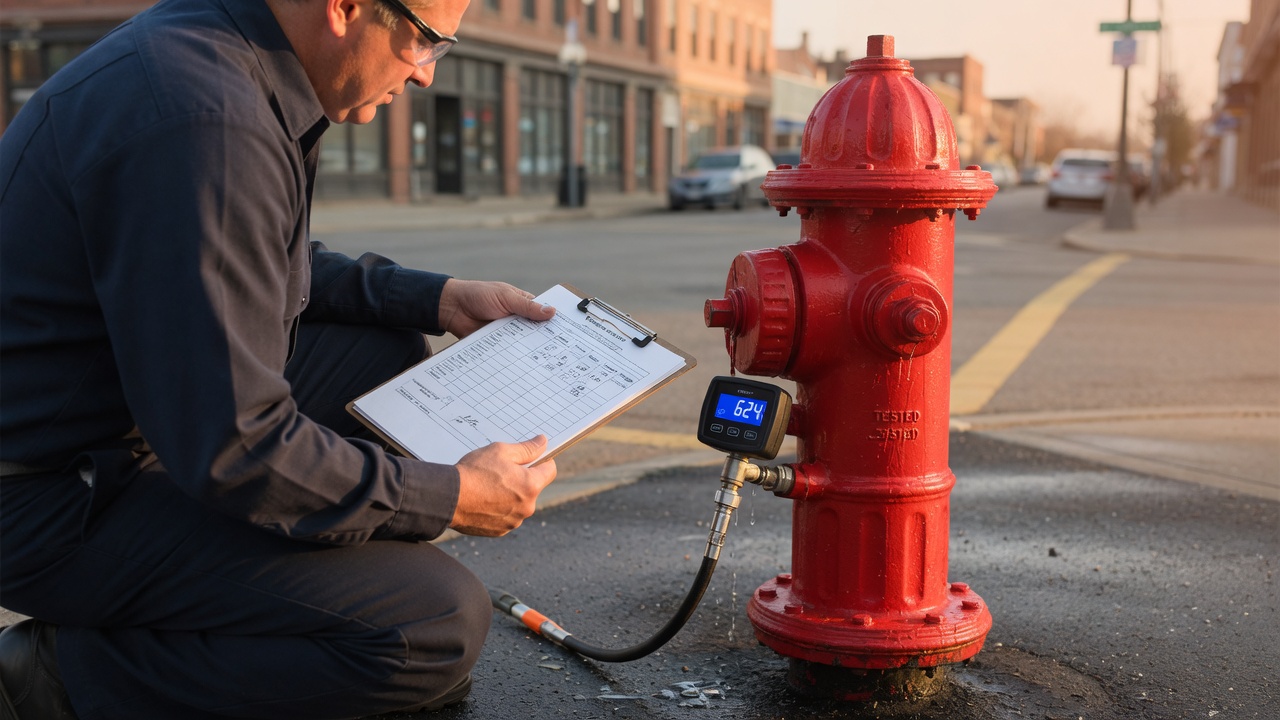
A hydrant flow test is only as useful as the record that survives it. Residual and pitot readings taken in the street mean little if the data sheet is incomplete, the hydrant IDs are ambiguous, the coefficient is assumed rather than stated, or nobody can produce photos, weather notes, and calculations when an authority having jurisdiction (AHJ), an Insurance Services Office (ISO) reviewer, or a sprinkler designer asks for proof months later.
This article treats documentation as the core of the work—not an afterthought. It walks through what a complete hydrant flow test report must contain under NFPA 291, how to build a field-to-office workflow from the data sheet through evidence packages and retention, and how those records feed water supply evaluations, main capacity assessments, and design. Whether you still use paper forms or digital apps, the standard is the same: every required data point captured once, calculated correctly, archived so it can be found, and handed off to the people who will rely on it.
If you came here looking for how to document fire hydrant flow test records so they hold up under review, start with the required data points—then build the archive and handoff process around them.
Why Sound Field Work Still Fails Review
cess. Too often a clean field effort still fails review—not because the pitot work was sloppy, but because the file that followed it was incomplete. Documentation defects are a different failure mode from testing technique errors. Missing hydrant IDs, unsigned sheets, no sketch or map linking residual and flow hydrants, ambiguous units, or calculations that cannot be recomputed from the raw numbers will sink a package even when every gauge reading was correct.
What reviewers check without re-running the test
An AHJ, ISO grader, or design engineer does not stand at the curb and re-flow the system. They validate three things on paper (or screen). Identity: can they tell, beyond doubt, which hydrant was residual and which flowed, with enough location detail, photos, or GPS that the pair cannot be swapped later? Date currency: is the test date, time, and weather clearly recorded and recent enough for the jurisdiction’s rules? Calculation transparency: do static, residual, and pitot pressures, nozzle coefficients, and resulting flows appear so someone can recompute available water supply without guessing intermediate steps? When any of those three is missing or murky, the file is not defensible.
Downstream cost of a thin file
The practical fallout is immediate. Permit reviews stall while the authority waits for a complete package or orders a re-test. ISO water-supply credit weakens because the documentation cannot support the claimed flows. Designers are forced to schedule and pay for fresh testing rather than rely on yours. Water-supply evaluations become disputed when the chain from field sheet to reported capacity is broken. None of that is fixed by better nozzle technique; it is fixed by a complete, traceable archive.
The rest of this article does not re-teach how to flow a hydrant. It builds the defensible file—starting with the minimum viable NFPA 291 data set and moving through evidence, retention, handoff, and the documentation mistakes that still trip teams up—so the work you already did in the street holds up when it reaches the people who will rely on it.
The Minimum Viable NFPA 291 Data Set: Required Fields and Traceability
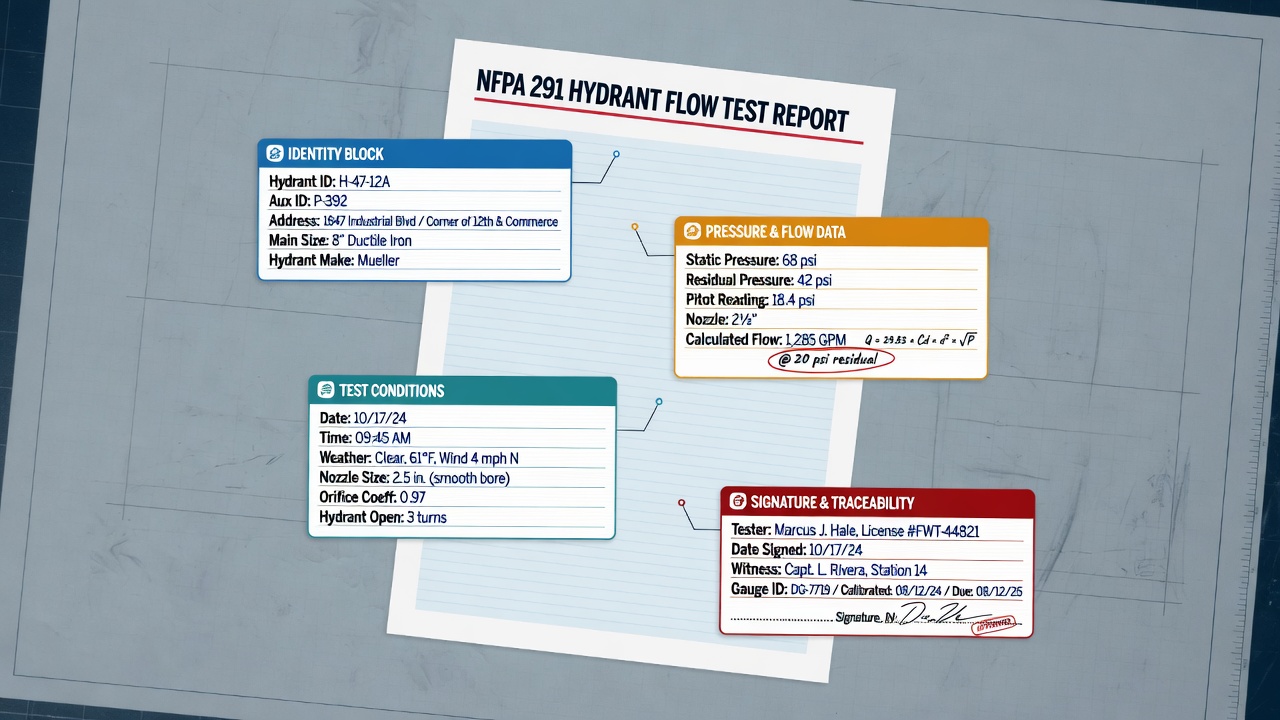
That package begins with a clear floor—the minimum viable data set NFPA 291-aligned practice expects before a flow test is treated as review-ready rather than a field note. Miss any of these anchors and the sheet loses the chain that lets an AHJ, ISO reviewer, or designer trust the numbers without standing on the curb themselves.
At minimum, a complete hydrant flow test report must lock down who tested, when and under what conditions, which hydrants were used, and what was measured and calculated. Non-negotiable fields include: unique IDs for the residual (static) hydrant and each flow hydrant; street address or GPS for every hydrant involved; static pressure, residual pressure, and pitot readings; outlet size and the discharge coefficient (C-factor) applied to each flowing outlet; calculated flow at the residual condition and any projected flows the report claims; date and time; weather; and tester identity (name and organization). Without those, the file cannot prove identity, currency, or calculation transparency.
Required fields at a glance
| Data point | What it establishes |
|---|---|
| Hydrant IDs + address/GPS | Which assets were residual vs. flowing; locates the test on the system |
| Date, time, weather | Currency and operating context for the reading |
| Tester identity | Accountability and who stands behind the sheet |
| Static / residual / pitot | Raw measured pressures and velocity pressure |
| Outlet size + C-factor | How pitot converts to gpm; no opaque coefficient |
| Calculated flows | Reported capacity at residual (and any stated projection) |
Traceability is the rule that turns that list into a defensible file: every number must map to a labeled hydrant and a known instrument condition. If a residual pressure cannot be tied to a specific hydrant ID on a sketch or map, or if the C-factor is written without outlet size and nozzle type, reviewers treat the calculation as opaque—even when the arithmetic is correct. Gauges, pitot tubes, and apps are part of that chain; note which instruments were used so a later reader can judge whether the readings were fit for purpose.
Optional fields that prevent later disputes
A short set of optional-but-valuable fields often separates a sheet that merely passes first glance from one that survives design and ISO scrutiny:
- Main size serving the test area, if known from utility records
- Adjacent valves closed for the test (or confirmation none were)
- Discharge direction and which outlets were opened
- Gauge and pitot calibration dates (or last verification)
- Notes on unusual system conditions the crew observed
Hold a simple mental model: the minimum viable report is the locked set above—enough to identify the hydrants, date the work, and show transparent static/residual/pitot math. An enhanced design/ISO package keeps that core and adds calibration evidence, valve status, main context, and clear graphics so the same file can feed sprinkler design, water-supply evaluation, and grading without a forced re-test. Capture the floor in the street; layer the rest before handoff.
Filling the Data Sheet in Capture Order
That handoff only works if the sheet itself was filled in the same order the crew took the readings—not rebuilt later from notes, photos, and memory. A defensible flow test data sheet is a chronological record: identity and conditions first, static next, flowing readings while the water is moving, assumptions written beside the numbers, then calculated results and attestation before anyone leaves the intersection.
Lock identity and conditions before the first gauge opens
Enter the residual (test) hydrant ID and the flow hydrant ID exactly as they appear on the utility map or asset tag, plus street address or GPS coordinates. Record date, start time, and weather in plain language—clear, 55°F, light wind—not a vague “good day.” Name the tester and company so accountability is already on the form. If you skip this block and fill it at the truck afterward, you invite the identity and currency failures reviewers catch first.
Static, then residual and pitot in one continuous capture
With the system at rest, read and write static pressure at the residual hydrant. In a typical two-hydrant setup you might record 68 psi static. Note gauge type (for example, liquid-filled 0–200 psi) beside the reading. Open the flow hydrant, stabilize flow, then capture residual at the test hydrant and pitot at the flowing outlet in the same moment—say 42 psi residual and 18 psi pitot on a single 2½-inch outlet. Immediately record outlet size, which port was used, and the coefficient: C = 0.90 for a smooth, rounded outlet, and state that you took C from the usual NFPA 291 outlet table so a third party is not left guessing.
Write the math and the assumptions so the result can be reconstructed
Compute discharge from the pitot reading, outlet diameter, and C-factor, then the available fire flow at 20 psi residual using the standard relationship. On the sheet, show both the intermediate discharge and the final available fire flow with units—for this example, roughly 508 gpm from the flowing outlet and an available fire flow on the order of 1,200 gpm at 20 psi, depending on the exact formula application your form uses. A reviewer should be able to plug your static, residual, pitot, outlet size, and documented C back into the same math and land on the same number. If main size, closed valves, or discharge direction are known, add them in the remarks line; they are optional for the floor package but cheap insurance against dispute.
Corrections that stay defensible
Never erase. On paper, strike through the wrong residual or pitot, write the correct value beside it, and initial and date the change. On digital forms, keep edit history or version stamps so an altered reading remains traceable to who changed it and when. Finish with a one-line available-fire-flow summary and the tester’s signature (and, where required, a witness) before the crew leaves the site. That sequence—identity, static, flowing readings, stated assumptions, calculated results, clean correction practice, attestation—turns street numbers into a sheet that can stand alone in an AHJ, ISO, or design file.
The Evidence Package: Photos, Sketches, GPS Tags, and Attachments
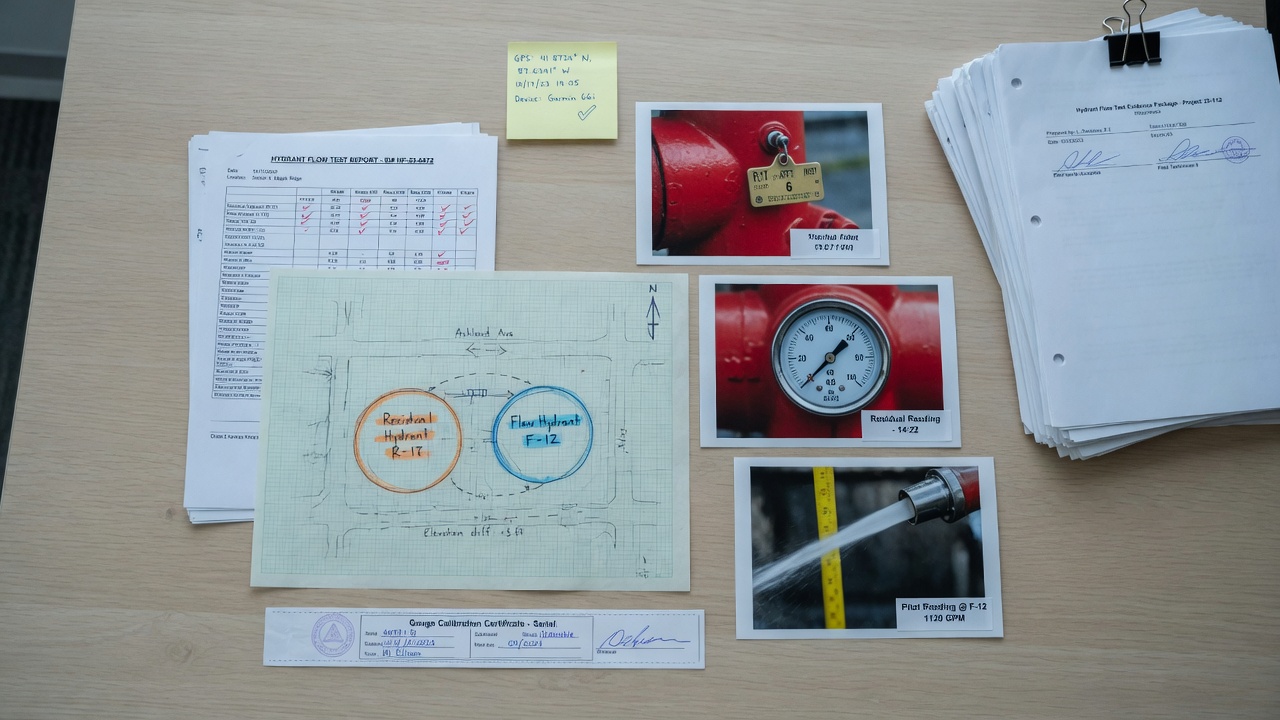
A clean data sheet is necessary, but it is not yet a defensible package. Reviewers who never stood at the curb still need to confirm which hydrant was opened, how the gauges were set, and whether the residual and flow hydrants match the map the designer or ISO rater will use. That is the job of the evidence package—attachments that lock every number on the sheet to a real place, instrument setup, and moment in time.
Minimal photo set that proves identity and setup
Capture four frames before the crew leaves: a close-up of the barrel or bonnet marking that shows the hydrant ID; the gauge on the residual hydrant so placement and reading orientation are visible; the discharge setup on the flow hydrant (outlet, pitot or flow device, and any diffuser); and one wide contextual shot that places the hydrant against a recognizable street corner, building face, or intersection. Those images let a third party verify that the labeled hydrant on the sheet is the one that was actually tested and that residual and pitot conditions match what the form claims.
One-page orientation sketch
Add a simple plan sketch—hand-drawn or digital—on a single page. Mark residual versus flow hydrants, show discharge direction, label street names, and include a north arrow. The sketch does not need survey precision; it only needs to let a designer or ISO reviewer orient the test without a site visit and confirm that the pair of hydrants used is the pair assumed in the water-supply evaluation.
Naming and tagging so files cannot drift
Standardize file names the same day: date, hydrant asset or GPS tag, and role in the test (for example, 2024-06-12_H-1847_residual-gauge.jpg). Embed or record GPS coordinates and the utility asset ID with the photos and the sheet. When every image carries the same hydrant key as the data sheet, a photo cannot silently attach to the wrong test months later when the archive is pulled for a permit or ISO review.
Thin PDF versus complete package
A thin submittal is a lone scanned sheet or a short PDF with no map, no photos, and no sketch. A complete evidence package holds the signed data sheet, the four-photo set, the orientation sketch, gauge calibration notes if available, and consistently named attachments tied to the same hydrant ID. The difference is what a reviewer can reconstruct without calling the tester back to the street.
Use this field checklist before demobilizing:
- Barrel/bonnet ID photo readable and matched to the sheet
- Residual gauge placement photo
- Flow-hydrant discharge and pitot/setup photo
- Wide context shot of location
- One-page sketch with residual vs. flow hydrants, streets, and north arrow
- Files named with date + hydrant/GPS tag + role
- GPS or asset ID recorded on sheet and in image metadata or sidecar note
One Master File, Four Audiences: Packaging for AHJ, ISO, Design, and Utility Use
flow hydrants marked completes the field kit. Once that evidence package is assembled, the work shifts from capture to handoff: the same master record must serve reviewers who care about different slices of the story. A defensible NFPA 291-aligned file is not rewritten four times—it is held once and wrapped with audience-specific cover material so source readings, photos, and calculations never drift apart.
What each audience actually needs
Authority having jurisdiction (AHJ) reviewers typically want a signed data sheet, clear hydrant identity, the orientation sketch or map, and enough calculation transparency to accept available fire flow without re-testing. ISO evaluations lean on credible available fire flow at the residual hydrant, test currency, and evidence that the test was run and documented in a recognizable professional form. Designers and fire-protection engineers need residual context they can put against sprinkler or standpipe demand—static and residual pressures, calculated discharge, available fire flow at 20 psi, and enough site layout to judge whether the test hydrants represent the supply path they are designing to. Water utilities need the same numbers as asset history: which hydrants were used, what the system delivered that day, and attachments that can be filed against the correct facility records.
Master record, thin cover sheets—not four rewrites
Keep one master package: the completed and attested data sheet, the four photos, the one-page sketch, gauge or instrument notes, and any calibration or C-factor support. From that master, generate short cover sheets rather than new source documents. An AHJ cover sheet can lead with project address, permit or plan number, test date, residual hydrant ID, available fire flow at 20 psi, and a signature block pointing to the attached sheet and sketch. An ISO-oriented cover can emphasize test date currency, the residual hydrant, and the reported available fire flow with a one-line method note. A design cover can add the static/residual pair, outlet and C-factor used, and a pointer to the sketch so the engineer can place the test on the site plan. A utility cover can key on asset IDs, main or zone labels if known, and internal work-order or GIS references. The numbers on every cover must quote the master sheet—never a retyped “summary” that can disagree with the field form.
Distribution, formats, and pressure confidentiality
Build a simple distribution list into the master file header or cover: AHJ plan review, ISO or insurance contact if applicable, design engineer of record, utility water or fire-flow records, and the testing firm’s archive. For long-term submittal and archive copies, use PDF/A (or an equivalent archival PDF) so the signed sheet, photos, and sketch stay locked together and readable years later. Keep an editable working copy of the data sheet only inside the utility or testing organization’s controlled system for asset updates—not as the version you email to outside parties. When sharing system pressures and available fire flow, treat the package as operational infrastructure information: send it to the parties who need it for code, insurance, or design decisions, avoid posting full residual and static detail on unrestricted public channels when local practice treats system pressures as sensitive, and follow the utility’s and AHJ’s rules on public-records requests so you neither over-share nor withhold what a legitimate reviewer is entitled to see.
Done this way, one NFPA 291-aligned master package supports permit review, ISO credit discussions, sprinkler supply design, and utility history without multiplying conflicting versions of the truth.
Retention, Chain of Custody, and Archive Choices That Survive Audit
That single master package only stays useful if it remains findable, attributable, and intact years after the gauges come off the hydrant. Retention should track the real lives of the data: long enough to bridge typical retest intervals, ISO grading cycles, and the full design-to-occupancy arc of a project—and longer still when a local AHJ or utility rule is stricter. Treat the shortest external requirement as a floor, not a target; water-supply history that disappears between grading visits or mid-project redesign forces expensive re-work.
Who holds the pen: defining chain of custody
Chain of custody answers four plain questions. Who captured the field readings and signed the sheet? Who performed QC review before the file left the crew? Who is the designated records custodian after handoff? And how is a superseding test marked so no one mistakes an older residual for the current system condition? Name those roles on the cover or in the file metadata. When a later test replaces an earlier one, keep the prior package but flag it clearly as superseded—date, reason, and pointer to the new master—so auditors see continuity rather than contradiction.
Paper, hybrid, or field app: what actually holds up
Paper binders still travel well in wet weather and need no login, yet they age, scatter, and resist multi-user search. Fully digital field apps excel at searchability, concurrent access, and locked edit history, provided the vendor export remains readable years later. Scanned hybrids—wet-ink or tablet-signed originals imaged to PDF/A and stored with the photos and sketch—often strike the best balance: durable courtroom and audit defensibility plus the ability to find a hydrant ID without opening a box. Whatever medium you choose, the master package must stay whole; a data sheet without its photos or a photo set without the signed sheet is a broken chain.
Protect against that failure with routine practice: consistent file naming that embeds hydrant ID, test date, and role (master, cover-AHJ, superseded); off-device or cloud backup that is not the same laptop that rode in the truck; and permission rules that separate capture/edit rights from long-term read access for designers and records staff. A lost hard drive should never erase the only copy of available fire flow for a protected property. Done this way, the archive remains as defensible as the day the residual gauge was photographed.
Putting the File to Work: Design Handoffs, Reuse Rules, and the Living Record
That same archive only earns its keep when the results move cleanly into the next job. A complete NFPA 291-aligned package becomes the water-supply foundation for sprinkler and standpipe design, formal water-supply evaluations, and main-capacity discussions—not because it teaches friction-loss math again, but because it hands the designer static and residual context, available fire flow at the residual hydrant, outlet and coefficient choices, and a sketch that shows which assets were actually used. The engineer can place the supply on a graph or model with confidence; the evaluator can cite a dated, attested source; the utility can compare the result against prior history for the same main. None of that works if the handoff is a bare number on an email.
What travels with every handoff
Treat the outgoing package as a short, self-contained set: the signed report PDF (or PDF/A export), the orientation sketch, clear hydrant IDs and locations, the test date and time, a plain note of any known system changes since the test (main work, valve status, pressure-zone shifts), and a named contact for questions. Audience cover sheets from the master file still apply—AHJ, ISO, design, or utility—but the underlying evidence stays one package so nobody is left reconstructing pitot math from a partial scan.
Reuse rules that keep stale sheets out of design
Reuse is not automatic. Age of the data must still fit the retest interval and the receiving AHJ’s acceptance practice. Any material system modification—new mains, closed valves, pump changes, or demand growth—retires the old residual and available-fire-flow figures for design use until a new test is run. Seasonal extremes matter when the original test was taken under atypical demand or temperature conditions that no longer represent the design case. When in doubt, confirm AHJ acceptance before locking a hydraulic calculation to an older sheet. A defensible file that is too old, or that no longer matches the system, is still the wrong file for the job.
Close the lifecycle the same way you opened the field sheet: each new test updates the living water-supply record for those hydrants and that main. Supersede the prior package, keep the chain of custody intact, and retire orphan PDFs that float outside the master file. Done consistently, the path from residual gauge to audit file stays continuous—and the next reviewer, designer, or ISO surveyor inherits a package that is still as clear as the day it was signed.