How to Read a Hydrant Flow Test Report: Static, Residual, Available Fire Flow, and Red Flags

A hydrant flow test report is not a grade to file and forget. It is a snapshot of how a water system behaves when a hydrant is opened, and the numbers only mean something if you can reconstruct what was measured, how pitot pressure became flow, and whether the stated available fire flow at 20 psi is physically possible.
Most engineers, fire protection designers, and site managers inherit these reports from a third party. The desk job is not to rerun the street test. It is to decide whether the document is complete enough for sprinkler design, hydraulic modeling, capacity questions, or a municipal approval—or whether it should go back for a retest.
This article reads the report the way a reviewer should: field by field, from static pressure and residual pressure through pitot (flow) pressure, the discharge coefficient, calculated hydrant flow, and the extrapolated available fire flow at 20 psi. It then shows how those values should hang together under NFPA 291 conventions, which red flags mean the main was never really loaded, and a practical accept-or-reject checklist.
A Finished Report Is a Decision Document, Not a Field Log
That accept-or-reject work is not for the person holding the pitot gauge. It belongs to the civil engineer sizing a main, the facility manager planning an expansion, the fire prevention officer reviewing a site plan, the sprinkler designer setting densities, and the developer chasing occupancy. None of them ran the test. All of them have to treat the signed report as capacity they can design and approve against—not as a field notebook they must reverse-engineer.
Once the form is signed, method choices are already locked in. Whether the crew treated the test as a hydrant-capacity shot or a main-capacity setup, which outlets they opened, and which discharge coefficient they applied all constrain what the available fire flow at 20 psi can honestly mean. Those choices travel into hydraulic calculations, authority having jurisdiction (AHJ) acceptance, and later rating or modeling work. A designer who quietly swaps them later is no longer using the same test.
The desk decision is whether the paper is trustworthy and, if it is, whether it yields a usable capacity number for a go/no-go call: enough water at 20 psi residual, or not. NFPA 291 is the reference frame for what a complete report should contain and how static, residual, and pitot readings are supposed to hang together—not a recap of field procedure. If the document does not look like a 291-style record, the first question is not what flow to design to. It is whether to accept the report at all.
What Each Field on the Report Is Really Asking
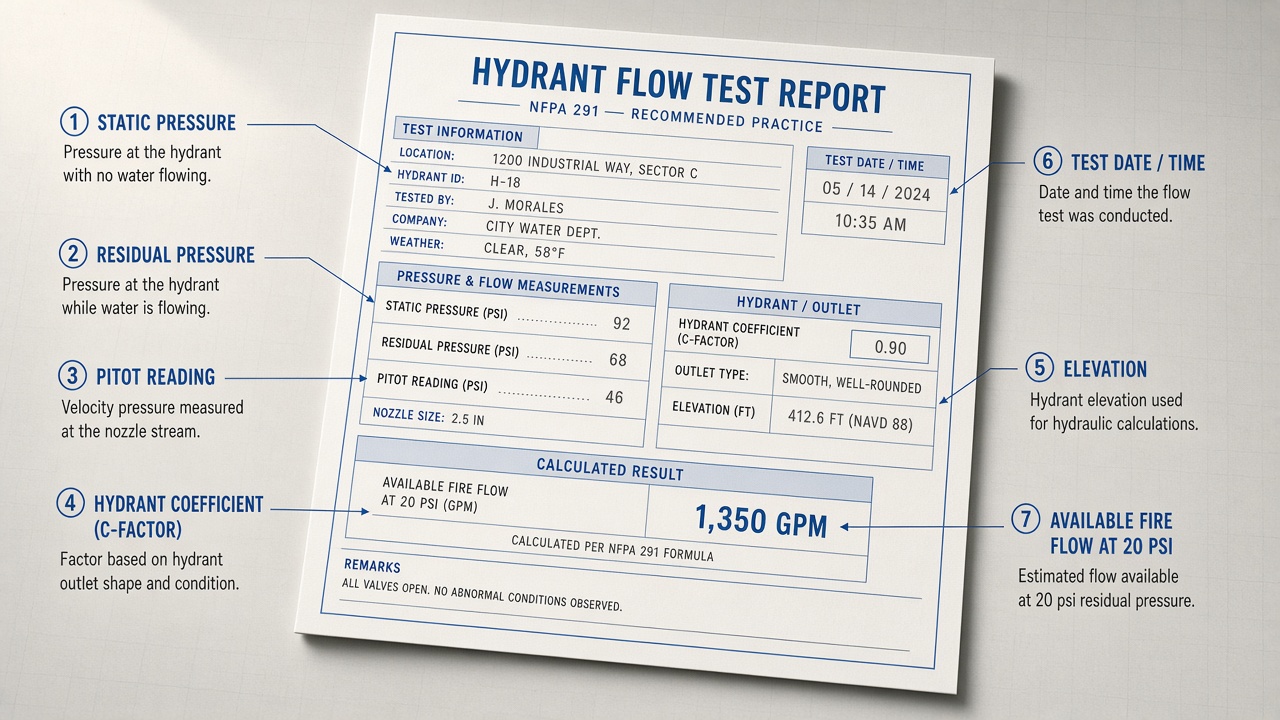
Once it does look like that record, the same discipline applies line by line. You are not hunting for a single gpm to paste into a model. You are matching each box to the question a designer, modeler, ISO reviewer, or AHJ is trying to close: is the supply adequate, what number is a legitimate model input, and what, if anything, can be credited as water supply.
Raw observations versus derived results
Static, residual, and pitot (flow) pressure are the field readings. Outlet size is hardware; the discharge coefficient is the C assigned to that outlet—an input, not a result. Calculated hydrant flow and available fire flow at 20 psi are derived. Date, time, and elevation (or a stated datum) are the conditions of the test. Recipients can recheck derived numbers from the page only when the raw pair, the outlet, and C are all present and labeled.
Translate the boxes into engineering questions
| Field | Kind | The real question |
|---|---|---|
| Static pressure | Raw | Does the system at rest have enough head to be a supply at all? |
| Residual pressure | Raw | Did opening the flow hydrant actually load the main? |
| Pitot / flow pressure | Raw | What velocity pressure was measured at the discharging outlet? |
| Outlet size | Input | Was the calculation based on the opening that was actually flowed? |
| Discharge coefficient (C) | Input | Is C realistic for that outlet, or a default that inflates gpm? |
| Calculated flow | Derived | Does printed discharge follow from pitot, diameter, and C? |
| Available fire flow at 20 psi | Derived | What capacity is being claimed for design, modeling, or credit? |
| Test hydrant vs. flow hydrant | Role | Are you seeing main capacity, or one hydrant’s barrel and laterals? |
| Date and elevation | Condition | Do the pressures still describe this site and this hydraulic grade? |
The same page is not a universal input. Sprinkler design needs a residual hydrant that actually loaded the main. A model needs roles and elevation. ISO credit and site approval need a dated capacity claim with the math still attached. Missing roles or orphaned derived numbers fail every use.
Treat the packet as incomplete if any of these are true
- Residual (test) hydrant and flow hydrant are not identified as separate roles
- Static and residual are missing, identical without explanation, or not tied to the residual hydrant
- Pitot or flow pressure appears without outlet size, or outlet size appears without C
- Calculated flow is printed with no path back to pitot, diameter, and C
- Available fire flow at 20 psi appears with no static/residual pair behind it
- Date is missing, or elevation or datum is omitted where grade matters
Static, Residual, and Why Capacity Is Quoted at 20 psi
Those last two gaps are the same failure. Available fire flow at 20 psi is a projection from a measured static-to-residual pair, not a free-standing result. If that pair is missing, identical without explanation, or not tied to the residual hydrant, the printed capacity is arithmetic without a test.
What static and residual mean on the residual hydrant
Static is the pressure at the residual (test) hydrant with no test discharge—the system in its normal operating condition, no extra draw from the flow hydrant. Residual is the pressure still on that same hydrant while the flow hydrant is open. One location, two states. The names describe the main’s response, not two different gauges.
The drop between them is the evidence that real demand was placed on the piping. Pitot and outlet size can print a flow on paper. Only a measurable drop shows that water actually left the system and the network felt it. A vanishing drop means the test did not load the main in a way that reveals capacity.
What the 20 psi benchmark does—and does not—promise
Available fire flow is quoted at 20 psi residual because that is the industry’s common paper benchmark for hydrant-main capacity. The figure answers one question: how much water this portion of the system could deliver if pressure at the residual hydrant were allowed to fall to 20 psi, using the observed static, residual, and calculated discharge as the measured point. Designers and AHJs use it so tests can be compared on the same residual.
It does not guarantee 20 psi at a building, a sprinkler riser, or the farthest hydrant on site. Elevation, pipe between the test hydrant and the point of use, and other draws on the main sit outside that number. Treating available fire flow at 20 psi as a site-wide promise is the usual misread of an otherwise clean report.
Keep the two residuals distinct. Residual on the test hydrant is the gauge reading taken while flowing—the second half of the pair. The 20 psi residual in the capacity statement is the reference the available-fire-flow calculation is reduced, or rarely raised, to. They share a name; they are not the same reading. A report that quotes residual only once leaves you unable to tell which you have.
Confirming Available Fire Flow From the Printed Numbers
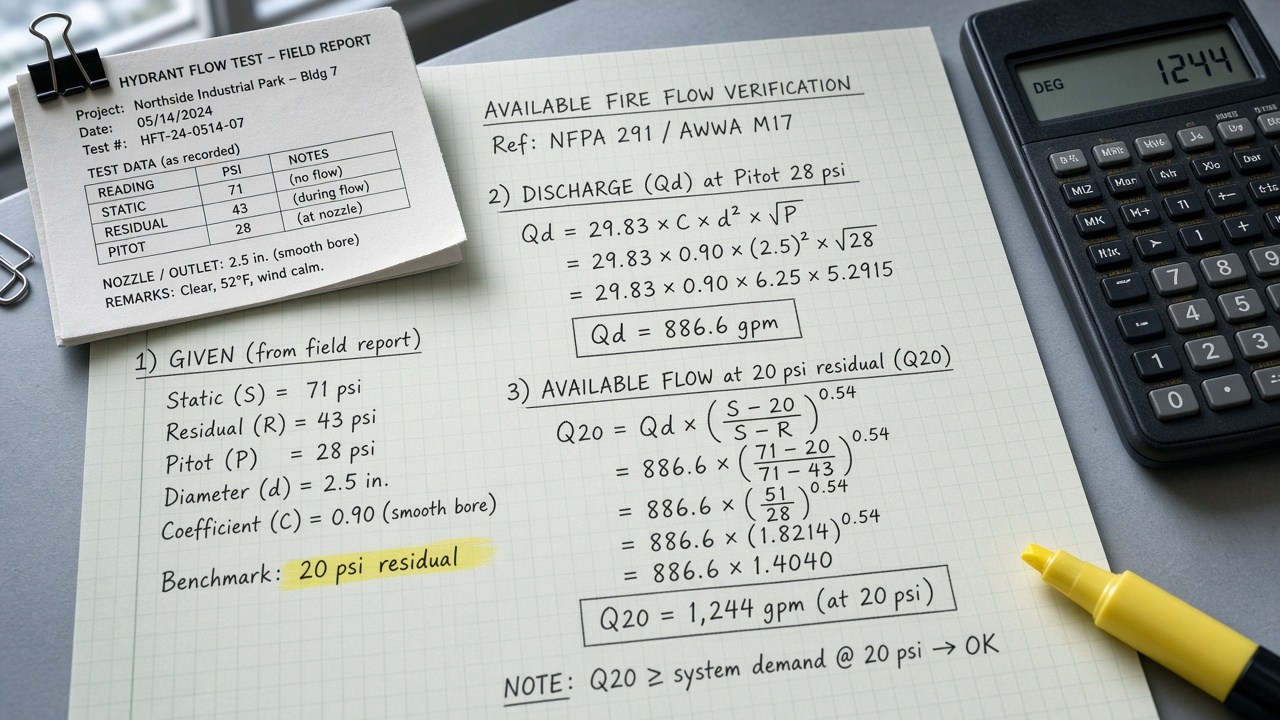
That is why the desk check starts by insisting both values appear, labeled, before any formula is trusted. With static, field residual, pitot, orifice size, and C-factor in hand, you can reconstruct both the listed discharge and the available fire flow at 20 psi without leaving the page. The question is not whether the numbers look large enough for a project. It is whether they are physically consistent with one another.
Reconstruct listed flow from pitot, orifice, and C
The standard hydrant discharge relationship converts pitot (velocity) pressure, outlet diameter, and the discharge coefficient into flowing gallons per minute. Apply the three inputs printed on the report with that equation. The result should match the listed calculated flow within ordinary rounding. A mismatch at this step is a transcription or unit error on the face of the document, not a difference between calculation methods.
C is a field claim, not a knob you turn to make capacity look better. Well-rounded hydrant outlets carry a higher coefficient than square or sharp-edged outlets; projecting interiors sit lower still. A coefficient outside the band that fits the outlet geometry described, or a diameter that does not match the outlet the narrative says was flowed, is enough to stop before the 20 psi step.
Extrapolate the same numbers to 20 psi
Available fire flow at 20 psi is the verified discharge scaled by the residual-pressure drop using the standard NFPA 291 residual-pressure relationship: form the ratio of (static minus the 20 psi paper residual) to (static minus field residual), raise it to the conventional exponent used in that practice, and multiply by the flow you just confirmed. Every term is already on a complete report. Keep the published exponent—not a rounded substitute—and keep the 20 in the numerator as the paper residual, not the field residual.
Work it once with the printed figures. Build the pressure ratio from static and residual, apply the standard exponent relationship, and multiply by the verified flow. The available fire flow quoted at 20 psi must land on that result. If the packet also includes a residual-pressure curve, treat the formula and the graph as the same hydraulic relationship drawn two ways. They should agree closely. A large gap between them is a reject signal, not a rounding footnote.
Mistakes that are visible without a retest
- Flow reported in litres per second treated as gallons per minute, or the reverse, with no conversion
- Outlet diameter taken from the steamer or barrel instead of the nozzle that was actually pitoted
- Static and residual swapped in the 20 psi formula, which inverts the drop and inflates capacity
- The standard residual-pressure exponent rounded off or omitted, which quietly changes available fire flow
- A C-factor copied from an older test or a default that does not match the outlet geometry described
If reconstructed Q and reconstructed Q20 both match the printed values, the report’s derived results are internally consistent. That is all this desk check can claim. It does not prove the field work was honest or complete — that filter comes next — but it does prove the page is not inventing capacity the recorded pressures cannot support.
Red Flags That Should Halt Design or ISO Use

That filter is the red-flag list: patterns visible on the face of the report that should halt design or ISO use even when the algebra already checks out. Any one of them should stop sprinkler design, ISO water-supply credit, and AHJ submission until the packet is qualified or the test is run again.
Field and documentation patterns
- Negligible static-to-residual drop. Residual almost equal to static means the flowing hydrant barely loaded the pipe, so available fire flow at 20 psi is a long extrapolation that overstates supply for sprinkler design.
- Residual already at or below a usable threshold. Residual near 20 psi, or so low the hydrant is effectively empty, describes a weak supply and invites AHJ rejection and weak ISO water-supply credit.
- Wrong or unexplained C-factor. Missing outlet type or nozzle condition is a documentation gap; a coefficient that cannot belong to the outlet shown requires a retest.
- Elevation ignored. Unrecorded grade differences among residual hydrant, flow hydrant, and the risk mean residual is not the pressure the designer thinks it is.
- Stale test date. Mains are cut, valves close, and demand is added; an old sheet can still describe a system that no longer exists.
- Internal math that will not reconcile. If printed discharge and available fire flow cannot be rebuilt from the static, residual, and pitot on the same page, stop—do not correct capacity in the margin and proceed.
Hydrant capacity mistaken for main capacity
A single-hydrant discharge is not a main-capacity supply evaluation, and a main test is not a certificate for a distant hydrant. Hydrant results describe what that hydrant delivered through the outlets used that day. Using those numbers as sprinkler supply overstates capacity; using a main test as if it certified a remote connection understates local friction and can still fail at the building.
Gaps you can patch versus a retest
Missing outlet size, unlabeled C, omitted elevation, or an unsigned sheet can go back to the tester. Negligible drop, unusable residual, irreconcilable pressures, never-established residual-versus-flow hydrant roles, or a date that no longer matches the system are not paperwork. Those require a full retest before anyone sizes pipe, claims ISO credit, or asks an AHJ to accept the number.
Accept, Qualify, or Retest
Those retest conditions are the hard stop. Everything else still has to be sorted into one of three recipient outcomes: full accept, accept with stated limitations, or reject and request a retest. The same validated static, residual, pitot, and available fire flow at 20 psi then feed different desks—sprinkler demand comparison, a pump-or-not call, ISO water-supply support, and AHJ submittal—without turning the report into a design tutorial.
Three outcomes, not a silent pass
Full accept is appropriate only when the printed numbers reconstruct a physically consistent available fire flow at 20 psi, residual and flow hydrant roles are identified, outlet size and a defensible C-factor are on the sheet, elevation is accounted for, and the test date still matches the system that will be designed or graded against. That packet can be compared to calculated sprinkler demand, used to decide whether a fire pump is in the conversation, cited for ISO water-supply credit, and attached to an AHJ submittal as the water-supply basis.
Accept with stated limitations when the hydraulics check out but the scope does not match the decision. A hydrant-capacity result is not a main-capacity supply for a large sprinkler calculation. A test taken before a main was cut, extended, or valved off does not describe the proposed layout. Write the constraint on the cover—what the number is good for, and what it is not—rather than silently discounting gpm.
Reject and request a retest when discharge or available fire flow at 20 psi cannot be reconstructed, the formula and residual-pressure-curve methods disagree, data are expired or follow a system change, elevation or outlet detail cannot be recovered from the sheet, residual is unusable, drop is negligible, or hydrant roles were never established. Those failures are not qualified into use.
Stamp the packet usable or send it back
Before anyone files the report, run this check. If every item holds for the stated purpose, the packet is usable. If any item fails, send it back.
- Static, residual, and pitot reconstruct listed discharge and available fire flow at 20 psi, and the formula and residual-pressure-curve methods agree.
- Residual versus flow hydrant roles, outlet size, and C-factor are labeled and physically plausible.
- Elevation and test date describe the system that will actually be designed or graded.
- Scope is correct: hydrant capacity versus main capacity, and current layout versus proposed work.
- Intended use is named—sprinkler demand check, pump trigger, ISO support, or AHJ submittal—with any limitation written, not implied.
- Failed math, method mismatch, missing elevation or outlet detail, unusable residual, or stale data trigger a retest, not a footnote.
A hydrant flow test report earns acceptance only when those checks pass. If they do not, the available fire flow is unused until a new test puts static, residual, and pitot back on a physically consistent number at 20 psi.