NFPA 291 2022 and 2025 Updates Every Tester Must Know

Fire-flow numbers only help if they describe the water system you actually tested, not the one a leftover rule of thumb assumed. That is the practical problem NFPA 291 now tries to solve. The recommended practice for fire flow testing and marking of hydrants did not throw out pitot tubes, residual gauges, or the classic flow formula, but the 2022 edition—and the 2025 follow-on—rewrote how testers choose a test, how far residual pressure is allowed to fall, when in the demand cycle to run, and how the hydrant is marked afterward.
If every job still opens as a multi-hydrant “main capacity” test, still chases a large residual drop, and still paints from memory, the crew is working a pre-2022 playbook. Readers who land here usually need the edition delta in field language: what a single-hydrant flow test is for, why a modest pressure drop (or the minimum practical drop) is now the target, how peak demand changes residual readings and available fire flow, and which color and reporting habits still match the current editions.
This article treats NFPA 291 2022 and 2025 as instructions, not committee history. You will get the distinction between hydrant-capacity and main-capacity tests, the safety and validity reasons for a smaller drop, timing against ordinary versus peak demand, marking and documentation updates, and a checklist for retiring old habits—plus the traps that still appear when testers mix NFPA 291 with NFPA 25 private-hydrant work, ISO grading, or sprinkler water-supply evaluations.
From 2019 Habits to 2022 Practice
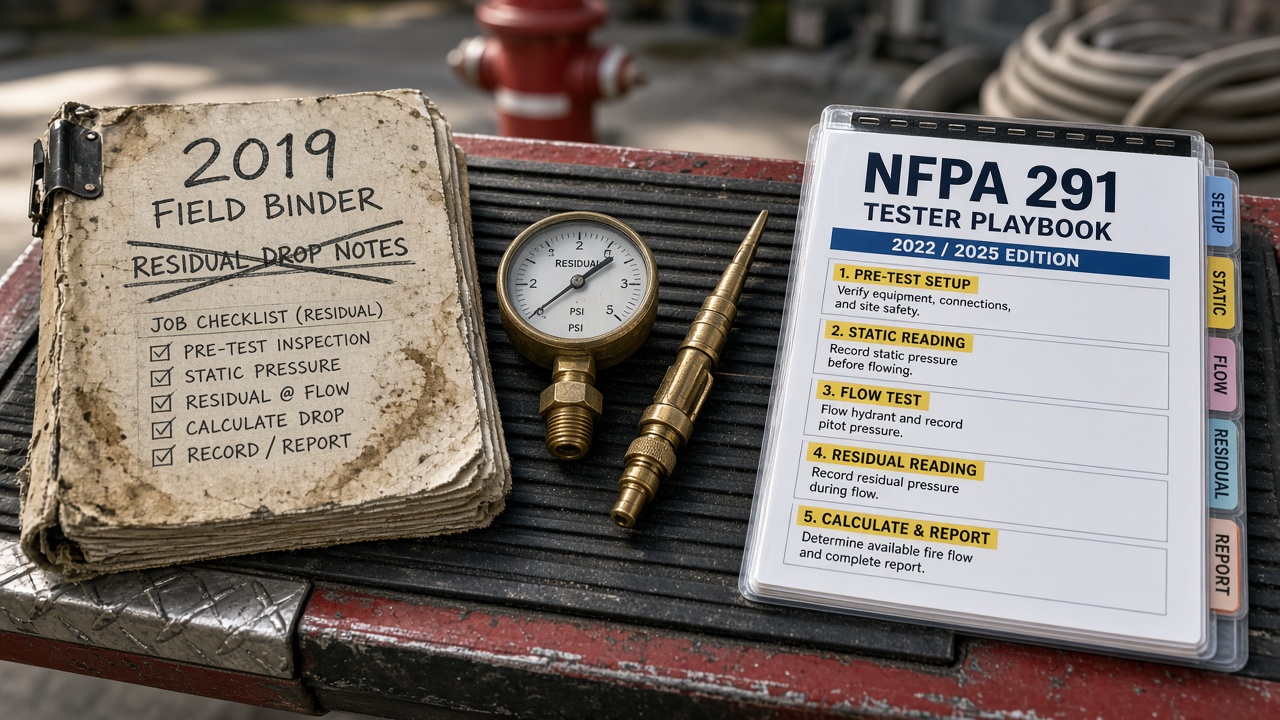
Those traps start with a category error. NFPA 291 is recommended practice for fire-flow testing and hydrant marking, not a substitute for the water utility’s operating rules, a municipal hydrant ordinance, or the authority having jurisdiction. When those sources conflict on who may open a hydrant, how far residual pressure may fall, or how barrels are marked, the local rule governs. 291 is the method for a valid test and for reporting fire flow so the number matches the test that was actually run.
The people who have to care are not only the crew on the steamer port. Flow testers and utilities own the field method and the public-system record. Fire protection engineers and facility managers inherit available fire flow for design, impairments, and insurance. Authorities having jurisdiction rely on the same figures when they accept a hydrant as adequate. Treat a 2019-era test as if it were a 2022 hydrant-capacity or main-capacity result, and the report and the paint on the hydrant can contradict the edition you claim to follow.
What 2022 closed that 2019-era crews still do
Crews working from 2019-era habit often treated a single flowing hydrant as a reading of the main, forced a large residual drop to see the curve, and tested when the street was quiet. The 2022 edition closed those gaps. It spelled out hydrant capacity as its own single-hydrant path, not a stand-in for the main. It asked for the smallest practical residual fall that still produces a trustworthy reading, which keeps the test nearer everyday operating pressure and away from a stress condition firefighters will never see. It also insisted that residual readings mean something only when you know whether ordinary or peak demand was on the system.
This article is the edition-delta playbook. Flows already covers common test mistakes, main- versus hydrant-capacity depth, pressure measurement, safety gates, and how results feed design and ISO work. Use those when you need the gauge or the application; use this piece to decide which old habits to retire.
Scan ahead for your gap
- How to run a single-hydrant capacity test the way the 2022 standard actually wrote it
- Residual drop and demand timing—why a modest, controlled fall is the valid one
- What the 2025 edition changed in procedure, marking, and reporting
- Choosing main-capacity versus hydrant-capacity on purpose
- Field kit, documentation, color coding, and a checklist for leaving pre-2022 habits behind, including mix-ups with NFPA 25 private hydrants, ISO grading, and sprinkler water-supply evaluations
How 2022 Wrote the Single-Hydrant Capacity Test
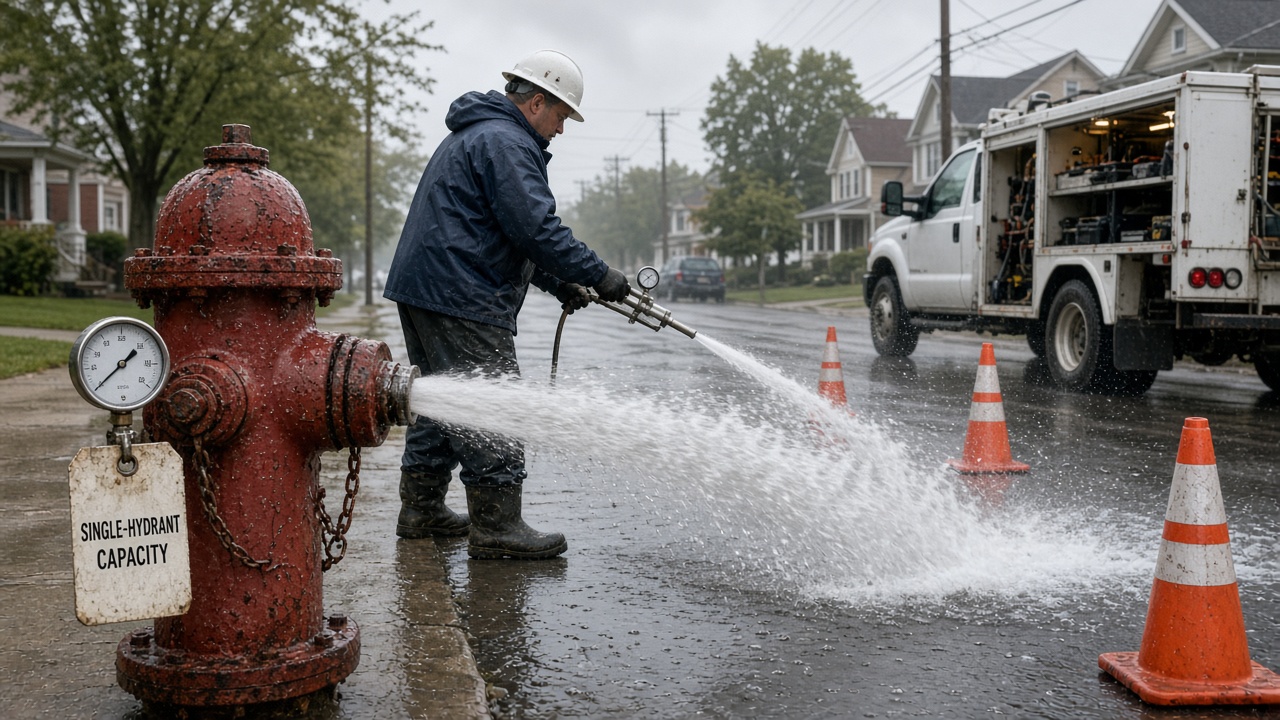
Start there: the single-hydrant capacity test is no longer an informal stand-in for a supply test. Flowing one hydrant is not new. What the 2022 edition did was write it as a first-class, documented procedure—with its own purpose, its own result, and its own limits.
What the test hydrant is actually doing
In a hydrant-capacity test, one hydrant carries both jobs. You take static on it, open one or more outlets, measure the discharge, and read residual on the same barrel while it is flowing. That residual is the hydrant’s own residual under its own discharge, not a remote system residual. The calculated capacity describes that hydrant at that location—not the main, the grid, or the water-supply figure a sprinkler designer would use for a building.
When a single-hydrant result is the right result
Use this path when the question is about the hydrant itself or a tight local patch of piping.
- Confirming individual hydrant performance against what the marking promised
- Local troubleshooting—closed valves, debris, or a repair that may not have restored discharge
- Limited-scope checks where you only need that hydrant’s capacity, not a district fire-flow picture
A main-capacity test is the other path: residual is taken on a separate hydrant while one or more hydrants flow, so the drop reflects the main and the surrounding network. For that choice side by side, see the site’s guide to choosing main-capacity versus hydrant-capacity. Choose the method on purpose before anyone opens a cap.
Write the method on the sheet so the result cannot be misread
Documentation is part of the procedure. Identify that this was a hydrant-capacity test, which outlets were opened, the static and residual readings, the measured flow, and the calculated capacity at the residual you actually produced. A bare flow number will be read as system supply. Make that misread impossible.
The most common misapplication is still the old one: one hydrant flowed, residual taken on the same barrel, and the calculated figure dropped into a sprinkler water-supply evaluation as if a multi-hydrant main test had been run. That is a different test answering a different question. Leave the result labeled as hydrant capacity.
Let Residual Fall About 10 Percent—or the Least That Still Works
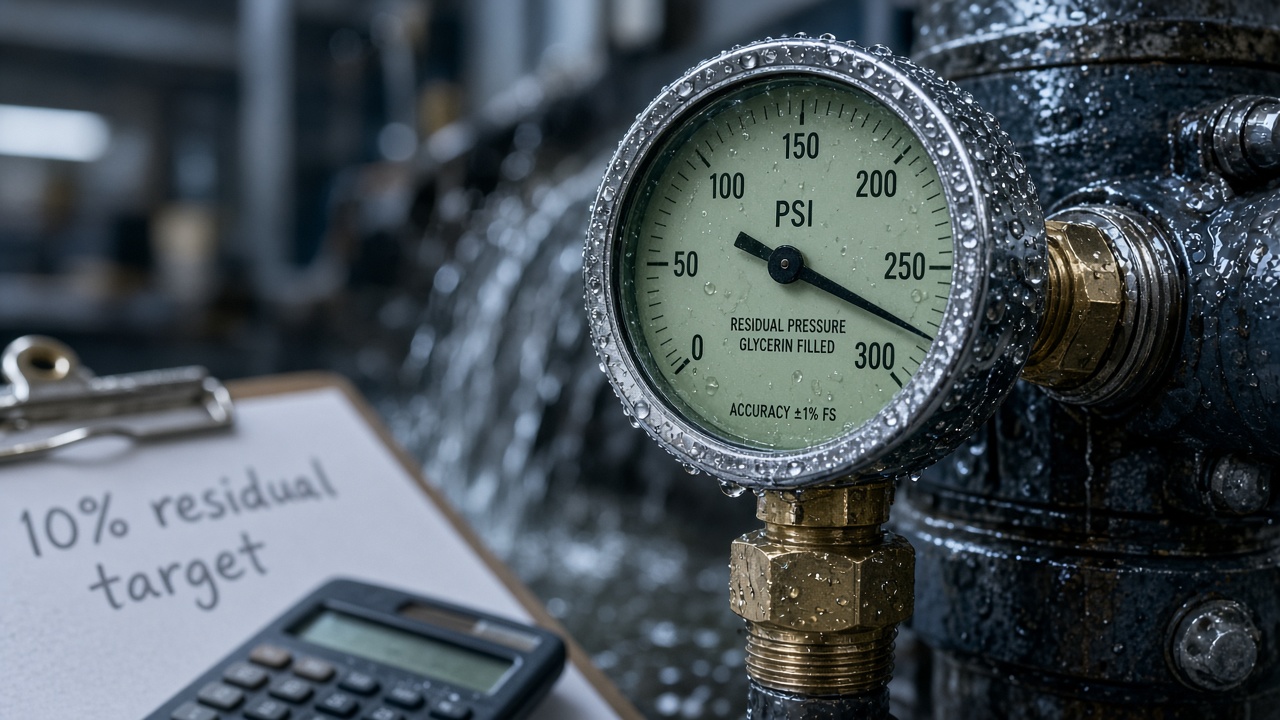
Once the result is labeled that way, residual drop is the next choice you make on purpose. Older crews often treated a large fall as proof the test was serious. The 2022 recommended practice walks that habit back: residual modestly below static, or the smallest practical drop that still yields a clean residual. The older chase of a large residual drop is the habit this edition is trying to retire.
Why a big drop makes the projection worse
When residual is driven far below ordinary operating pressure, projected available fire flow no longer describes the hydrant or the main as they actually run. You are sampling a friction range the system may never see in fire service. A deep draw also puts more water in the street than the data require and can pull neighboring services toward low-pressure complaints—stress and hazard without better numbers.
A smaller, intentional drop keeps residual in the band where the hydrant works day to day, so the reading represents operating conditions instead of a collapse. Gauges settle more readily, residual is easier to hold long enough to record well, and low-pressure side effects are less likely. Clean residual—not dramatic residual—is what makes the hydrant-capacity calculation honest.
Plan the fall; stop when the data are usable
- Choose tip and outlet count to produce a measurable residual, not the largest stream you can get.
- Increase discharge only if residual barely leaves static.
- Stop at the smallest drop that yields a stable, usable residual reading.
Treat any SOP that still requires a large residual fall as a red-flag legacy rule. It belongs to the 2019-era habit of treating residual drop as a trophy, and it fights the 2022 practice if it shows up in the field book. None of this replaces the three readings the math actually uses. Static, residual, and pitot quality still govern the calculation. A well-chosen drop cannot rescue a bouncing gauge, a residual connection in the wrong place, or a pitot that is not in the stream. Get those measurements right rather than re-deriving formulas in the street; the drop guidance only tells you how far to go while you take them.
Time the Test Against Peak Demand, Not a Quiet Street

Those same gauges also inherit the system’s demand at the instant you open the hydrant. A clean static and residual pair on a quiet street is not the picture you would get while the community is drawing hard. After method and residual fall, timing is the third control the 2022 edition expects you to choose on purpose.
When the result will inform available fire flow, a sprinkler water-supply evaluation, or an ISO-oriented supply picture, recommended practice is to work at or near peak demand, or to state plainly that you did not. Ordinary off-peak residuals sit higher because neighboring services are not competing for leftover head. Open the same outlets during the evening domestic peak, a plant shift, or irrigation season and residual can fall far enough that the filed number no longer holds.
Coordinate with the utility and the clock
Ask the utility what SCADA or zone demand shows for the window you want. Prefer a time that captures diurnal, industrial, or irrigation peaks rather than the first empty hour on the calendar. If peak access is refused or unsafe, run what you can—and label the condition so nobody treats an ordinary-demand residual as peak-influenced.
Record more than the two pressures
Pressures without a clock are incomplete. Capture:
- Date and time of the static and residual readings
- Known demand context: ordinary, near-peak, peak, or unknown
- The static/residual pair itself
- Whether the test represents peak-influenced conditions
That note keeps a hydrant-capacity or main-capacity result from being reused as a design supply it never was. Sprinkler calculations and grading pictures need leftover head that remains when the community is already drawing.
When off-peak data is not enough
Re-test when the only file is clearly off-peak and a conservative design or supply rating is required. Return also if zone demand has changed—new industry, expanded irrigation, a different pump schedule—or if the prior report never said when the gauges were read. Choose the test type on purpose, drop residual only as far as you must, and take the readings when the system is actually working.
What Testers Should Watch in the 2025 Edition
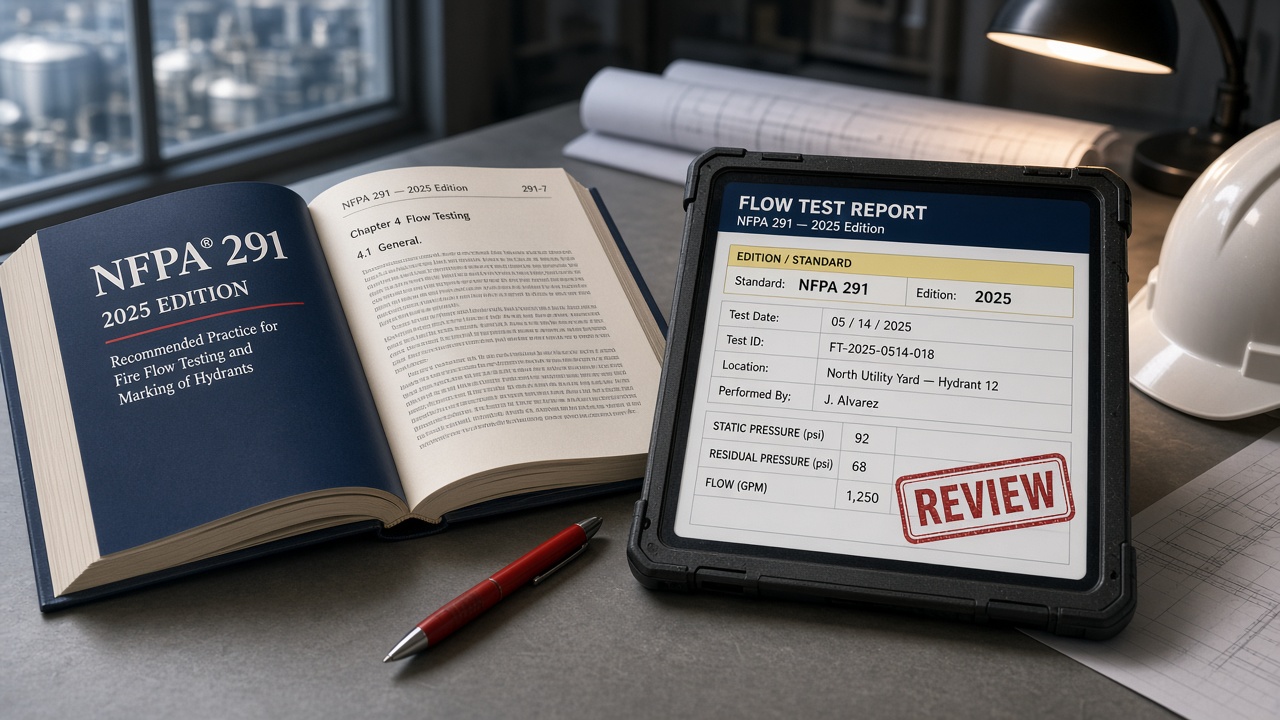
Those three choices still govern the work when a new cover date appears. The 2025 edition is the next text to check against them—not a reason to reopen older habits. Verify the published 2025 NFPA 291 recommended practice and whether your utility, contract, or AHJ has actually adopted it. Until that is explicit, dual-track. You may still be working to 2022, a locally amended cycle, or language that never left the SOP. If those parties cite different books, name the controlling text on the report rather than assuming the newest cover wins.
What is worth watching in the field
Expect the 2025 cycle to refine wording around the same controls already in play. Watch four practical themes.
- Test-type clarity, so a hydrant-capacity result is never presented as main-capacity or as a sprinkler water-supply proof.
- Residual and drop guidance carried forward: a modest, stoppable fall, not a return to chasing a large drop.
- Marking and color practice aligned with the capacity you actually calculated, so paint and tags match the test that was run.
- Report content that stays consistent: method labeled, units held through every reading, and the rated-capacity basis clear for the AHJ and for design users.
Calculation and presentation stay disciplined either way. Label hydrant-capacity versus main-capacity. Keep units consistent from static through residual, pitot, and projected flow. State the residual at which capacity is rated so an AHJ or a design user is not guessing leftover head.
Close 2019 language still sitting in the kit
Run a short internal gap analysis on SOP clauses, field forms, training slides, and color-marking specs that still treat a single hydrant as the main, default to a quiet street, or treat a large residual drop as good practice. Replace those lines with the 2022 controls, then overlay only what the adopted 2025 text actually changes. Confirm the book in force, keep the method honest, and update paperwork only where the new edition or the AHJ requires it.
Match the Mark to the Test You Ran
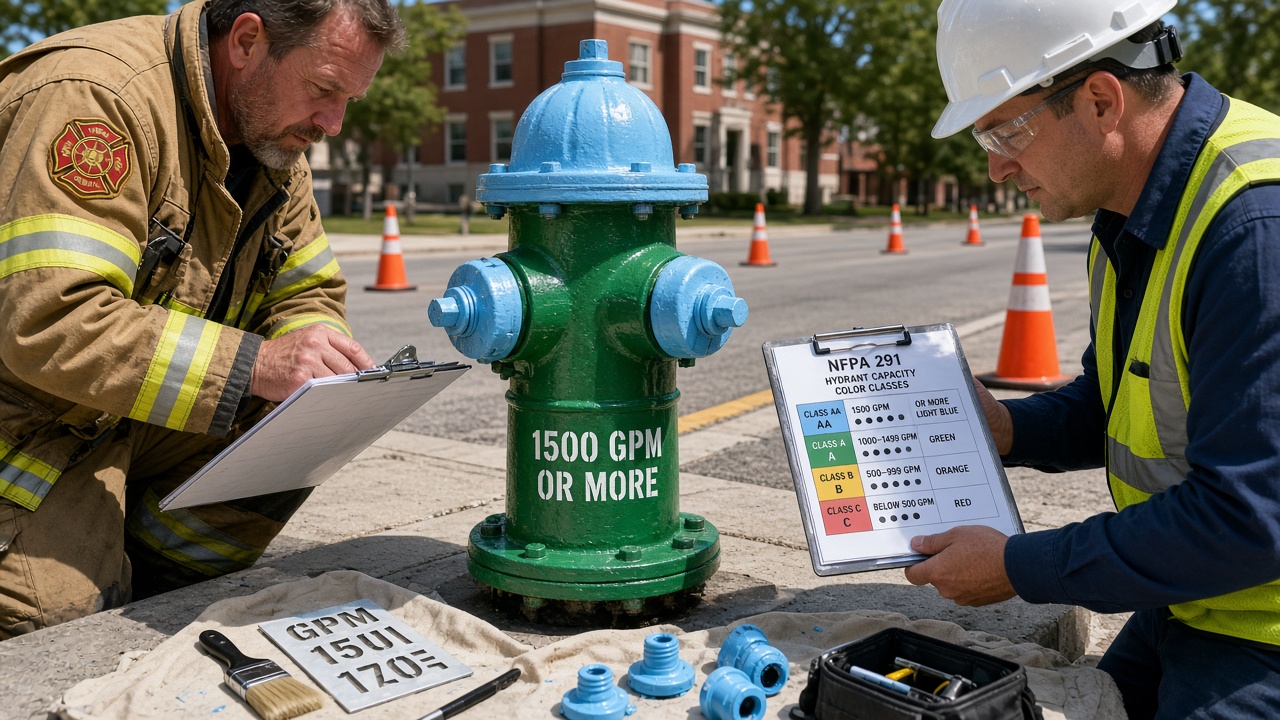
Paperwork is not the last step. Once the method, residual, and demand window are honest, the hydrant in the street still has to carry that same story. NFPA 291’s class colors exist so fire crews and water-supply planners can read flow capability at a glance. That only works if the paint matches the capacity class from the test you actually ran—hydrant-capacity or main-capacity—not an older, more generous number still sitting on the barrel.
When a retest forces a new color
A hydrant-capacity result describes that hydrant, not the main. Switching away from a multi-hydrant main-capacity figure, correcting a prior test that chased a large residual fall, or capturing residual at peak demand can all move the hydrant into a lower class. Any of those corrections is a marking event. Leaving legacy colors in place is the field equivalent of keeping a 2019 SOP on the form: inflated or method-mismatched tests painted as high-flow hydrants will keep being treated that way at the curb even after the report is cleaned up. If the calculated capacity no longer supports the class, repaint. When an adopted 2025 text tightens how rated capacity is labeled on the report, the mark has to follow that label too.
Coordinate the scheme—and keep paint with the record
NFPA 291 recommends class colors; many utilities and fire departments adopt those bands, amend them, or use an alternate local scheme. Confirm which standard governs—AHJ, utility specification, or NFPA-aligned bands—and who is authorized to paint public versus private hydrants before anyone opens a can. Decorative or branding colors on bonnets and caps that fight the coded meaning defeat rapid recognition.
- Repaint when the capacity class changes after a compliant retest.
- Document the test date that stands behind the mark.
- Skip decorative colors that conflict with the coded class.
Photograph the hydrant before and after the update. A high-class bonnet that followed an aggressive, off-peak, or mislabeled test should give way to the class that matches the labeled method and the residual you measured. File those images with the report so the next crew can see why the color moved and the mark stays aligned with the math.
Close the Upgrade: Checklist, Red Flags, and Related Work

That same discipline—method, residual, mark, and the paper trail that ties them together—is what the rest of the upgrade comes down to. Current recommended practice is a closed loop: the test you choose, the residual you allow, the demand you stand in, the report you label, and the color you leave on the street all have to agree.
A concise upgrade checklist
Walk the program against this list before the next round of tests:
- Confirm the edition cited—and any local amendment—before you change a form or a paint spec.
- Select main-capacity or hydrant-capacity on purpose; do not default to one hydrant and call it the main.
- Target the modest residual fall already described, or the least practical drop that still works.
- Record demand timing and whether conditions were at or near peak.
- Label the method, outlets, and rated-capacity basis on every report.
- Update markings to match the test actually run and keep the photo trail with the file.
- Refresh training and forms so they no longer teach pre-2022 defaults.
Red flags that the old habit is still running
Correct these if they still show up in an SOP, a spreadsheet, or a painted bonnet:
- Mandatory large-drop language leftover from older field rules.
- Unlabeled single-hydrant data treated as system or sprinkler supply.
- Off-peak-only residuals used when a conservative design picture is required.
- Retests that changed the class but left the old color in place.
- Packages missing a traceable static, residual, and pitot set.
Where the result goes next
Private hydrant flow work often sits beside an NFPA 25 inspection and testing program. Recommended practice under 291 tells you how to run and document a capacity test; NFPA 25 keeps private hydrants on their own inspection, testing, and maintenance cycle. Do not let one stand in for the other.
When the same numbers have to support sprinkler water-supply evaluation or ISO grading, use Flows’ applications coverage on putting hydrant-test results to work. For street staging and the usual field errors, the phase-gate safety and common-mistakes pieces remain the place for execution discipline.
None of that holds if the kit is sloppy. Carry calibrated gauges, control the diffuser and tip so the residual stays modest and stoppable, protect the public, and hand the AHJ a package that names the method, the demand context, the readings, and the mark that followed them. The reported fire flow has to match the test you actually ran.