
Applying Flow Test Results to Fire Sprinkler Design, Water Supply Evaluation & ISO Ratings
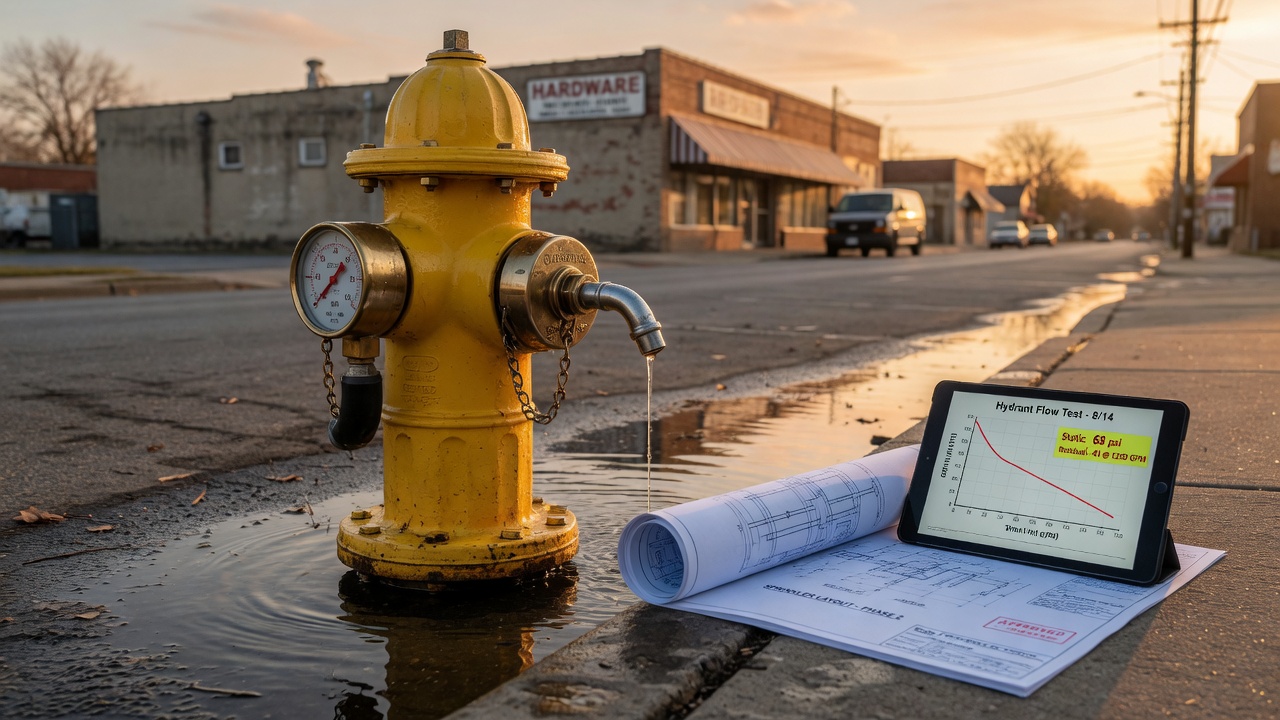
A hydrant flow test ends with three field numbers: static pressure, residual pressure, and a pitot reading that becomes flow. Those numbers only become useful when they are projected to available fire flow at 20 psi residual and laid against the most demanding NFPA 13 sprinkler demand. That single comparison decides whether the municipal supply is adequate, whether a fire pump or tank is required, how much ISO water-supply credit the site can claim, and whether the package will clear the authority having jurisdiction.
This article gives the field-to-desk framework for making that comparison correctly and defensibly. It covers how to turn raw hydrant data into a reliable supply curve, when the curve triggers supplemental water or redesign, why hose-stream demand stays separate from sprinkler demand unless the AHJ says otherwise, how the same numbers feed ISO Needed Fire Flow scoring and hydrant-program credit, and what documentation actually belongs in a submittal. The aim is evergreen, practical guidance you can apply on the next project without re-deriving the code basis each time.
Vetting Flow-Test Data Before It Enters Your Design
Before any Hazen-Williams projection or demand comparison begins, the raw hydrant numbers themselves have to clear a few gates. Bad or incomplete test data does not become reliable simply because it is plotted on a supply curve; it has to be rejected, retested, or completed first.
Start with age. Flow test data for sprinkler submittals must typically be no older than 12 months—some jurisdictions tighten that window to 6 months—to satisfy NFPA 13 expectations. Anything outside the local acceptance period is discarded before a single hydraulic comparison is run. Stale static, residual, and pitot readings no longer describe the water supply the sprinklers will actually see on the day of a fire.
Age alone is not enough. The test must produce a meaningful residual pressure drop so the later projection is hydraulically stable rather than flat-line noise. Industry practice looks for a drop commonly of at least 10 percent from static; without that change the Hazen-Williams relationship has too little slope to extrapolate available fire flow at 20 psi residual with any confidence. A trivial drop means the test is incomplete and should be redone at higher discharge.
How and when the test is staged matters just as much as the readings. Single-hydrant shots taken in the middle of the night often paint an optimistic picture. Multi-hydrant layouts that pull from the same main, timed for peak-demand periods, yield the more conservative, defensible supply curve a designer can stand behind when the authority having jurisdiction reviews the package. The objective is not the flattering number; it is the number that still holds when the rest of the neighborhood is drawing water.
Treat field details as design inputs
Finally, capture every supporting detail while the gauges are still on the hydrants. These items travel with the data into the hydraulic model and the submittal; treating them as afterthoughts weakens the entire chain from street test to approval.
- Gauge calibration dates and certificates
- Outlet coefficients actually used for each flowing hydrant
- Clear assignment of hydrant roles (flow versus residual)
- Exact test date, time of day, and noted system conditions
- Hydrant locations and which main they share
Once the data set clears these checks—current, meaningful drop, defensibly staged, fully documented—it is ready to be turned into the available-fire-flow decision point that drives every later choice in the design.
Projecting Available Fire Flow at the 20 psi Supply Point
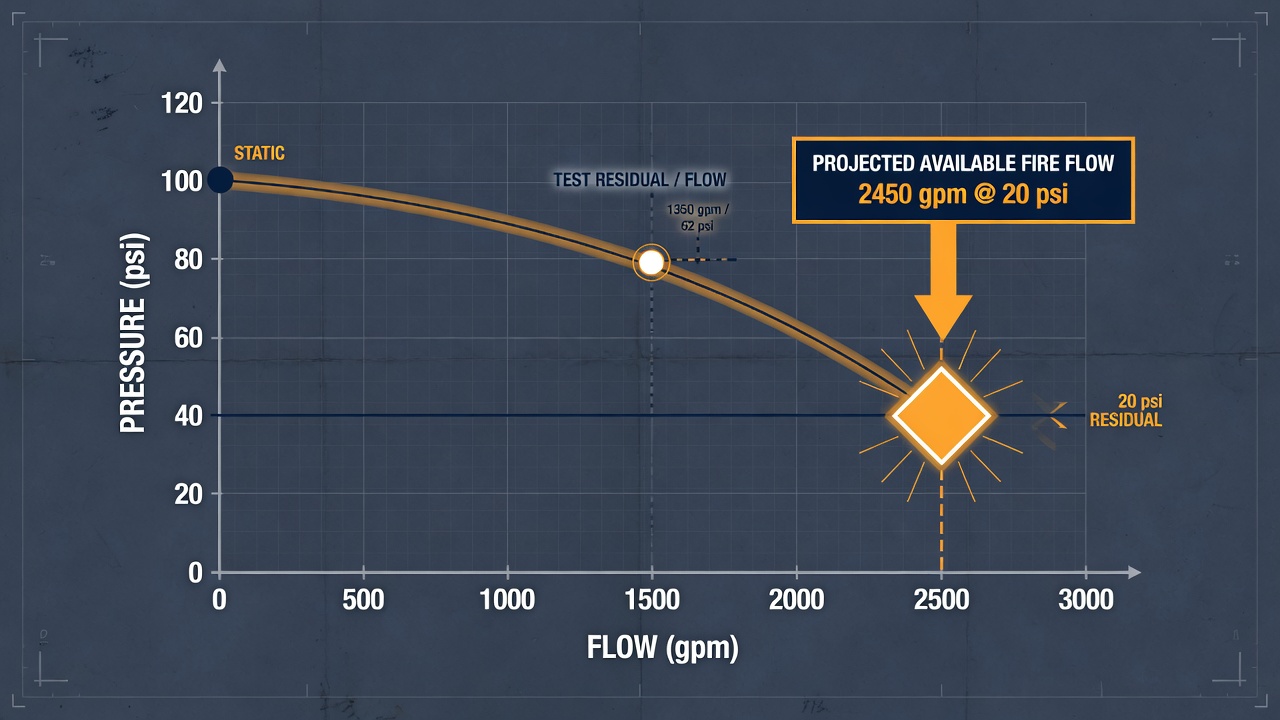
With vetted static, residual, and pitot readings in hand, the next move is to convert that field set into one usable design number: the available fire flow (AFF) at the residual pressure your design and the utility will honor. That pressure is almost always 20 psi. The conversion rests on the Hazen-Williams relationship that links the observed drop to the larger drop needed to reach the 20 psi floor. In standard form the projection is AFF = Q × ((S − 20)0.54 / (S − R)0.54), where Q is the measured flow from the flowing hydrant(s), S is the static pressure, and R is the residual pressure recorded while flowing. The result is a single point—gallons per minute available at 20 psi residual—that sits on the supply curve you will later overlay on sprinkler demand.
That 20 psi residual floor is not an arbitrary design preference. Many water authorities prohibit residual pressures below 20 psi because of back-siphonage and water-quality concerns; NFPA 291 itself flags the same limit. Keeping the municipal or private main above that threshold protects the public system while still giving the fire-protection designer a conservative, widely accepted supply node. Inside the building the picture changes. NFPA 13 only requires 7 psi at the most remote orifice—enough to open the sprinkler and produce a spray pattern. The two limits therefore operate at different places in the analysis: 20 psi governs what the water supply is allowed to deliver at the connection point; 7 psi governs the minimum pressure that must still exist at the sprinkler itself after all friction losses through the system.
Once calculated, the AFF point becomes the municipal or private supply node entered into hydraulic calculation software. In most day-to-day designs it is treated as a fixed head-and-flow boundary condition: the software draws the supply curve through the static pressure and the projected 20 psi AFF point, then compares that curve against the most demanding sprinkler design area. The projection is not, however, a substitute for full network modeling when the authority having jurisdiction requires it. Large campuses, weak grids, or sites where multiple fire-protection systems can operate simultaneously may still need a calibrated pipe-network analysis that accounts for simultaneous demands, pipe condition, and valve status. In ordinary commercial and industrial work, though, the single projected AFF point is the decision datum that tells the designer whether the public or private supply alone can satisfy the sprinkler demand or whether a fire pump, tank, or redesign must be introduced.
Because every subsequent go/no-go call—pump sizing, tank volume, ISO water-supply credit, and the AHJ supply-versus-demand package—rests on this one number, the arithmetic and the residual-pressure basis must be transparent, repeatable, and tied directly to the vetted field data. With the supply point now fixed at 20 psi, the design can move cleanly into the comparison against actual sprinkler demand.
Supply-vs-Demand Go/No-Go: Adequate and Deficient Worked Cases
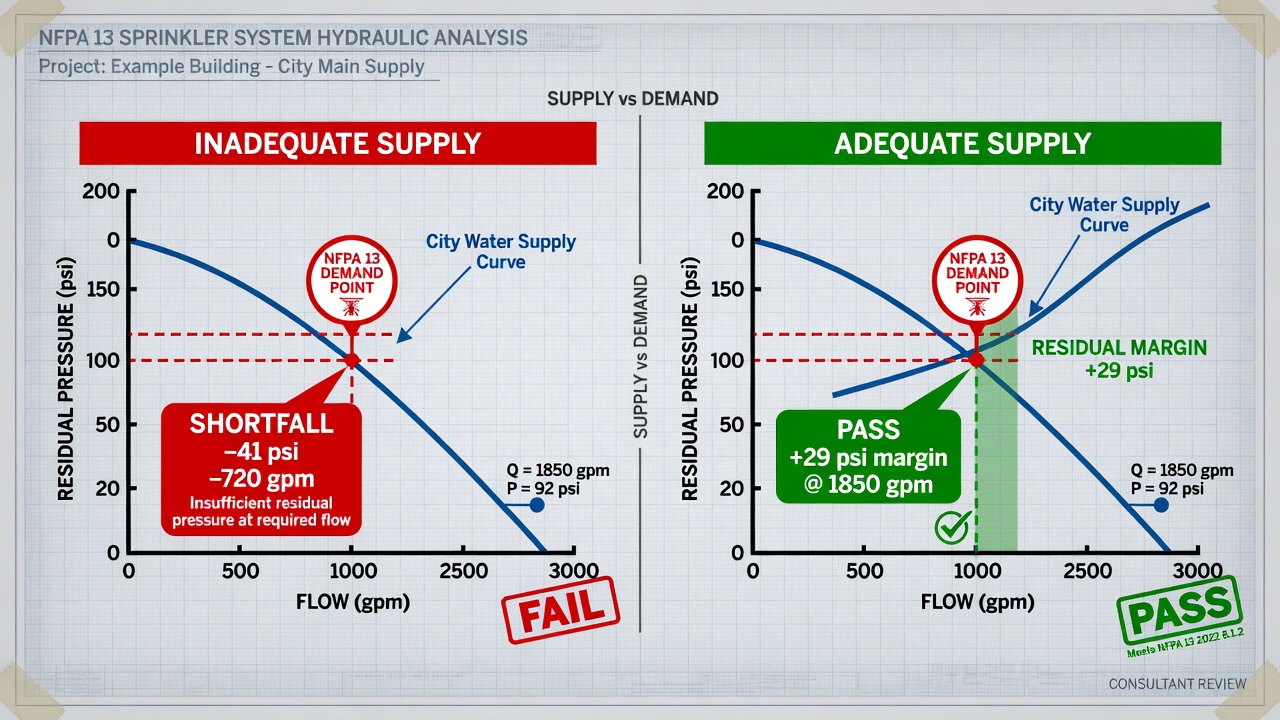
That comparison is the go/no-go hinge for the entire design. The projected available-fire-flow (AFF) point at 20 psi residual is laid directly against the most demanding design-area flow and pressure produced by the NFPA 13 hydraulic calculation. If the available supply exceeds the system demand at the required pressure, the system may be designed without supplemental pumping. If the available supply is insufficient, additional measures such as a fire pump, tank, or system modification may be required.
Two residual-pressure anchors must stay distinct. The site supply check uses the projected AFF residual basis—commonly the 20 psi utility and backflow floor already fixed in the previous step. Orifice-level checks inside the tree itself are anchored to the NFPA 13 minimum residual (flowing) pressure of 7 psi at any sprinkler. Confusing the two produces either an overstated shortage or an unsafe under-design.
Keep hose demand out of the sprinkler comparison
NFPA 291 and standard model practice treat firefighting hose demand and sprinkler demand independently unless the authority having jurisdiction (AHJ) explicitly requires a combined evaluation. Adding municipal hose flow on top of the sprinkler demand curve is the fastest way to force an unnecessary pump or tank. Run the sprinkler supply-versus-demand check on its own numbers; document hose capability separately for the fire department and for ISO Needed Fire Flow credit later.
Worked adequate case: supply clears demand with margin
Consider a light-hazard office floor whose remote design area demand sits well below the projected supply curve. Plotting the supply curve shows available residual comfortably above the demand node and well above the 7 psi orifice floor. Usable residual margin remains after friction losses through the underground and backflow preventer. No fire pump or tank is indicated; the designer can proceed with a city-pressure system and simply document the supply-versus-demand overlay for the AHJ package.
Worked deficient case: shortfall forces the next decision
Now change only the demand side. An extra-hazard storage occupancy produces a remote-area demand that pushes the same supply curve below the required pressure at the riser. Even though the AFF number at 20 psi may still exceed the required flow, the pressure available at the actual demand point is deficient. That shortfall is the explicit trigger for a fire pump, a suction tank, a reduced design area or density where the standard permits, or a combination of those measures. The next section details how to size and justify each path; the essential point here is that the go/no-go call is made at the demand node, not merely by comparing raw gpm figures at 20 psi.
Both cases use identical field data and the same 20 psi projection method; only the demand node changes. That is why transparent arithmetic and a clear residual-pressure basis matter: the single AFF point feeds every subsequent decision, yet the decisive comparison always occurs at the pressure the sprinklers actually need.
When Shortfalls Trigger a Fire Pump, Tank, or Redesign
Once that comparison shows a shortfall, the next step is deciding what to do about it. Fire pumps are installed when the available water source cannot meet the flow and pressure demands of the most demanding water-based fire protection systems onsite. The trigger is not a rough feel for “weak pressure”; it is a documented gap between the projected available fire flow (AFF) at 20 psi and the hydraulically most remote design-area node after a vetted test and a clean supply-versus-demand check.
Not every shortfall points to the same fix. Separate pressure-limited cases from flow-limited ones before you specify equipment. In a pressure-limited case the municipal or private main can deliver the required volume, yet residual pressure collapses below the node’s needed pressure once flow is drawn; a fire pump that boosts pressure while drawing from that same source is usually the direct remedy. In a flow-limited case the source simply cannot furnish the gallons per minute the design area demands, even if residual pressure looks acceptable at lower flows; here a suction tank, elevated tank, or pressure tank supplies the missing volume, often paired with a pump if the tank alone cannot deliver the required residual at the sprinklers. When both volume and residual are deficient, the combination of tank plus pump is the typical path.
Before defaulting to added equipment, test whether a modest demand-side redesign closes the gap. Adjusting the remote design area within NFPA 13 limits, selecting a lower but still compliant density for the occupancy, or upsizing key pipe runs can reduce the pressure and flow the node requires enough to bring it under the existing AFF curve. These moves are especially worth examining when the shortfall is only a few pounds or a few dozen gallons; they avoid the capital, power, and maintenance burden of a pump or tank while still satisfying the code. Larger or structural shortfalls, of course, still drive equipment.
Whatever path you choose, document the decision logic on the same test data used for the hydraulic calculations. Show the static, residual, and pitot readings, the Hazen-Williams projection to 20 psi, the demand-node flow and pressure, the resulting surplus or deficit, and the explicit reason a pump was added, a tank was sized, both were specified, or a redesign was accepted instead. Authorities having jurisdiction can then see that the go/no-go call and the equipment choice rest on one transparent AFF point rather than on an opaque judgment call. That package also becomes the baseline for future re-tests and for any later ISO water-supply evaluation that draws on the same supply curve.
How the Same AFF Point Translates into ISO Water-Supply Credit
That same projected available fire flow at 20 psi residual is the figure ISO uses when it scores a community’s water-supply capability. The supply curve you already built for the sprinkler go/no-go decision—static, residual, pitot data reduced through Hazen-Williams to the 20 psi floor—slots directly into the water-supply portion of the Fire Suppression Rating Schedule. You do not recalculate a different residual or invent a second test; you simply present the AFF point against the flows ISO cares about rather than against a single remote-area sprinkler demand.
Community eligibility versus building Needed Fire Flow
ISO first checks whether the water system as a whole can support a stronger Public Protection Classification. For a community to be eligible for PPC Class 8 or better, the supply must deliver at least 250 gpm for two hours, and that fire flow sits on top of the community’s maximum daily consumption for ordinary uses. Once that threshold is cleared, ISO turns to individual buildings and assigns each a Needed Fire Flow. Building NFFs range from a minimum of 500 gpm to a maximum of 12,000 gpm; full credit is awarded only when the water supply can deliver the stated rate at 20 psi residual for the required duration. Those NFF values are deliberately broader than the single most-demanding sprinkler design-area node you used earlier. A warehouse whose remote sprinkler demand is modest may still carry an ISO NFF of several thousand gpm once construction, occupancy, and exposure factors are applied. Keeping the two numbers distinct prevents you from overstating sprinkler adequacy as automatic ISO credit, or from understating community capacity when the sprinkler demand happens to be modest.
Hydrant programs that add FSRS points
Forty percent of a community’s PPC grade rests on water supply. Inside that share, ISO awards additional credit for the type and installation of hydrants and, critically, for any documented program of hydrant inspection and flow testing. Public hydrants should be flow-tested every five years to verify capacity and marking; communities that maintain that cadence—and keep the inspection records—receive measurable points beyond the raw delivery of NFF. The same quality markers you already insisted on for design (recent test date, meaningful residual drop, calibrated gauges, multi-hydrant layout) therefore serve double duty: they make the sprinkler supply curve defensible to the AHJ and they strengthen the water-supply score ISO assigns the jurisdiction.
Strong sprinkler documentation and strong ISO water-supply scoring share the same test quality and the same 20 psi residual basis, yet they answer different evaluators. The AHJ wants proof that the most demanding design area will operate above the NFPA 13 orifice minimum; ISO wants proof that the community can deliver building-scale NFFs and that hydrants are inspected and re-tested on a five-year cycle. One transparent AFF point and one disciplined testing program satisfy both audiences without forcing two separate field campaigns.
From Test Sheet to Submittal: Building the AHJ Documentation Package
That single AFF point only earns its keep when the package around it is complete, transparent, and reusable. The file that travels with the design should let a plan examiner, fire marshal, or insurance reviewer reconstruct the supply curve, verify the go/no-go decision, and confirm that the data still meet currency and residual rules without a follow-up call.
What belongs in the core attachment
Start with the field record itself: test date and time, exact hydrant locations and the role each played (static/residual versus flow), static and residual pressures, pitot readings with outlet diameter and coefficient, calculated flow (Q), and the projected available fire flow at 20 psi. Attach gauge calibration evidence so the residual drop and pitot values cannot be challenged on instrument grounds. These elements turn raw hydrant data into a defensible supply node rather than a number on a sketch.
Supply-versus-demand narrative
Pair the numbers with a clear supply-curve versus system-demand comparison—graph or tabulated nodes—and a concise one-page narrative that states the outcome in plain language: adequate as-is, deficient and requiring a pump or tank, or resolved by modest demand-side redesign. Keep hose stream demand separate unless the authority having jurisdiction has already directed otherwise; note that choice explicitly so the reviewer does not assume an unstated combined load.
Anticipating the usual objections
Cross-reference the package to the rules the AHJ will apply. Cite the water-supply currency window required by NFPA 13 (commonly twelve months, sometimes six), confirm that the residual basis for the AFF projection is the 20 psi utility/backflow floor while orifice checks remain anchored at the 7 psi NFPA 13 minimum, and flag any local combined-demand or peak-period testing preferences. Answering those points inside the submittal prevents the most common review cycles before they start.
Maintain one source-of-truth test attachment. Reuse that same sealed record for hydraulic calculations, fire-pump or tank justification, and any later ISO or insurance inquiry. When the field data, the AFF projection, the supply-versus-demand comparison, and the narrative all point to the same transparent 20 psi supply node, the package closes the loop from hydrant to approved design without forcing a second field campaign or a second set of numbers.