How Often Should Fire Hydrants Be Flow Tested? NFPA 291, NFPA 25, AWWA M17 & Local Requirements Explained
Ask how often fire hydrants should be flow tested and you will hear “every year,” “every five years,” and “every ten years”—often in the same conversation. Those answers are not contradictions. They name different tests, different owners, and different standards.
Public hydrants on the municipal grid are usually governed by water-utility practice and guidance such as NFPA 291, which states that public fire hydrants should be flow tested every 5 years to verify capacity and marking. Private hydrants on a site fall under the owner’s inspection, testing, and maintenance duties in NFPA 25: an annual full-open flow for function and debris clearing, plus a full pitot-measured capacity test on a longer cycle. AWWA M17 frames system-wide flow testing as good practice on a roughly decade-scale rhythm or after major change. ISO scoring for public protection often expects fire-flow tests across the distribution system every 5 years for full credit. Local codes and the authority having jurisdiction (AHJ) can tighten any of those clocks.
This article separates those clocks so you can tell annual operational flow from true available-fire-flow capacity tests, map public versus private responsibility, and build a defensible calendar that still bends when mains, developments, or design needs change. The next section unpacks why the published intervals conflict before the rest of the piece maps test types, ownership, schedules, and reset triggers.
Why Hydrant Flow-Test Frequencies Always Conflict
The reason those published intervals conflict is straightforward: most frequency answers mash together four different clocks—public-system guidance, private inspection-testing-maintenance rules, insurance credit criteria, and water-utility best practice—then treat the result as one number. Collapse those sources and every authority appears to contradict the others.
NFPA 291 is the document most often quoted for a tidy cycle. Some sources and local practices note that it requires fire hydrant flow tests every 5 years and inspections annually. In reality the standard is recommended practice; its adoption status and mandatory force still vary by jurisdiction and by how the authority having jurisdiction writes the local code. Ask three different reviewers and you can receive three different answers about whether that five-year figure is binding.
Language makes the muddle worse. Annual “flow” wording that appears in private-hydrant rules usually means opening the hydrant fully, letting it run long enough to verify operation and clear debris, then shutting it down. That is not the same exercise as a pitot-measured available-fire-flow test that records static and residual pressures, calculates discharge in GPM, and updates capacity marking. One is an operational check; the other is a system-capacity measurement. They sit on different clocks yet share the same casual verb.
The remainder of this article therefore stops hunting for a single universal interval. Instead it treats frequency as a choice among clocks: who owns the hydrant, which test is actually required, and which body is scoring compliance. Once those three questions are answered, the schedule becomes defensible—and it can still flex when mains are upgraded, large developments come online, or design data is needed.
Operational Flow vs. Capacity Flow: Two Tests on Separate Clocks
That second question—which test is actually required—is where most schedules quietly break. People say “flow test” for two different jobs, and each job runs on its own clock. Until you can tell them apart on a work order, asking “how often?” is premature.
Operational testing: prove the hydrant works
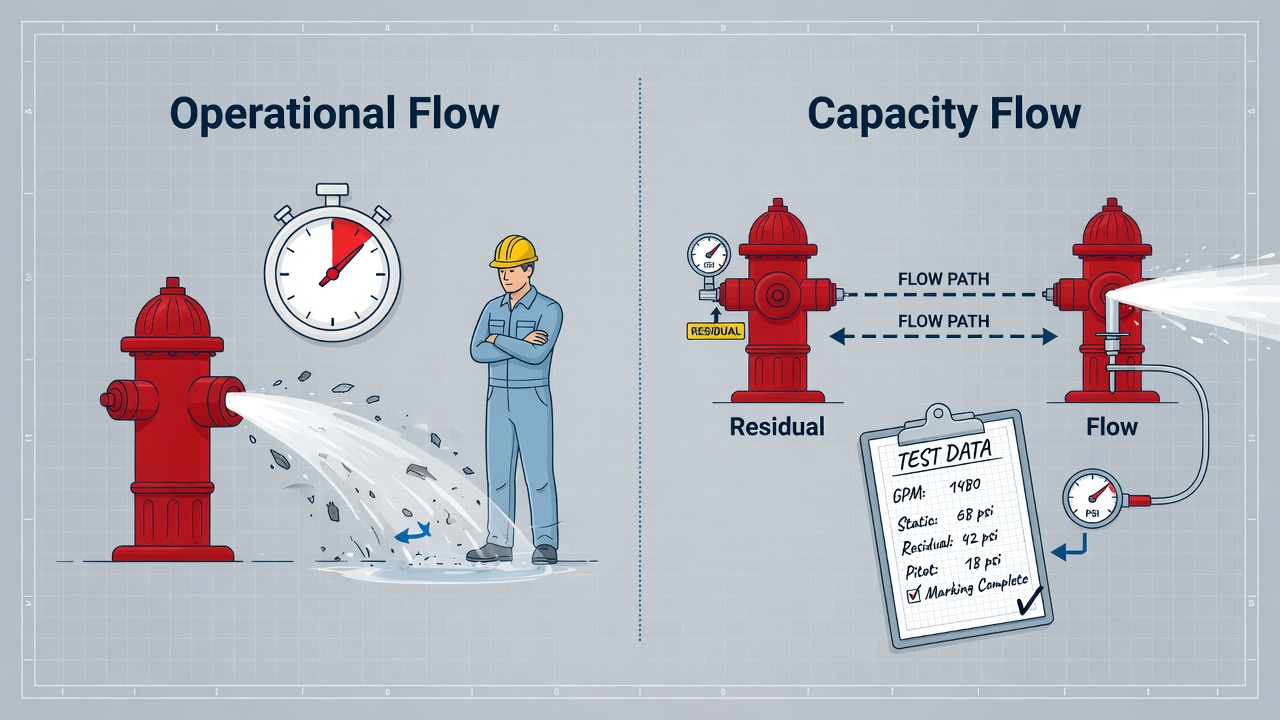
Operational testing is a function check, not a supply study. The hydrant is opened fully, water is flowed long enough to clear foreign material, and the unit is confirmed to operate, drain, and shut without issue. Under NFPA 25, private hydrants are opened fully and water is flowed until debris clears, with flow maintained for not less than 1 minute. That timed flush verifies the hydrant will perform when needed; it does not establish available fire flow, support color-coded marking, or document system capacity. Think of it as the annual “does it open and run clean?” clock.
Capacity testing: measure what the system can deliver
Capacity testing is a measurement exercise. Crews record static pressure, open one or more flow hydrants, read residual pressure at a residual hydrant, and take pitot readings on the discharge so flow can be calculated in GPM. The results establish available fire flow, support hydrant marking, and document how the distribution system actually performs. This is the multi-year “what can this main deliver?” clock—and it is a different scope of work from a one-minute flush.
| Dimension | Operational flow | Capacity (available-fire-flow) test |
|---|---|---|
| Primary purpose | Confirm the hydrant opens, flows clean, and shuts properly | Quantify available fire flow and system performance |
| Typical measurements | Full open, clear discharge, drain/operation check | Static pressure, residual pressure, pitot discharge (GPM) |
| Usual setup | The hydrant under test | Residual hydrant plus one or more flow hydrants |
| What “pass” looks like | Opens fully, clears debris, functions as intended | Usable residual drop and valid multi-hydrant readings |
| Clock it feeds | Operational / ITM clock | Capacity / marking / supply-data clock |
Satisfactory capacity results need a meaningful pressure drop and a proper residual-plus-flow setup. NFPA 291 guidance calls for flowing enough water to produce at least a 10% drop from static to residual; weak systems may need only one or two flow hydrants, while strong systems may need several. Single-hydrant shortcuts undermine usable results: neither NFPA nor AWWA recommend the single-hydrant method for determining available water supply, and insurance grading programs often will not treat those readings as accurate.
Before you ask how often a hydrant should be “flow tested,” label the work order. If the task is open-fully, clear debris, and confirm function, you are on the operational clock. If the task is static/residual/pitot measurement for GPM, marking, or design data, you are on the capacity clock. Frequency only makes sense after that label is fixed.
Who Owns the Hydrant? Public Utility vs. Private Property
Once you know whether you need an operational check or a full capacity measurement, the next filter is ownership. Frequency tables only apply after you know whose rulebook governs the hydrant—and that split is sharper than most site teams expect.
Public hydrants sitting on the municipal distribution system are typically maintained and scheduled by the water purveyor or the fire department. Their testing cadence follows public-practice guidance, utility policy, and whatever the local authority having jurisdiction has adopted. The property owner next door does not set that calendar and is not the default party responsible for opening, flowing, or documenting those units.
Private on-site hydrants are a different clock entirely. Private hydrants are owned by the property owner, located on private property, and are the property owner's responsibility to maintain under NFPA 25 Chapter 7. That means the annual operational work—visual inspection, full opening, flow of not less than one minute, lubrication, and records—lands on the facility’s inspection, testing, and maintenance program, not on the city by default. Capacity-style pitot work on the private supply side follows the same ownership line unless a written agreement with the utility says otherwise.
Misassigned ownership is one of the most common reasons private sites skip annual operation or quietly assume the municipal five-year program already covers them. A hydrant that looks identical to the one across the curb can still sit on a private main; when that distinction is missed, both the operational clock and the capacity clock drift, and documentation gaps show up only when an insurer, AHJ, or design engineer asks for proof.
Before any later frequency table is applied, run a quick ownership screen: Is the hydrant on public right-of-way and fed by the distribution system, or is it on private property fed by an on-site service or private main? Confirm with site plans, the water purveyor, or the AHJ if the line is unclear. That single label determines which standard—and which clock—you open next.
Public Hydrant Testing Schedules: NFPA 291, AWWA M17, and ISO Credits
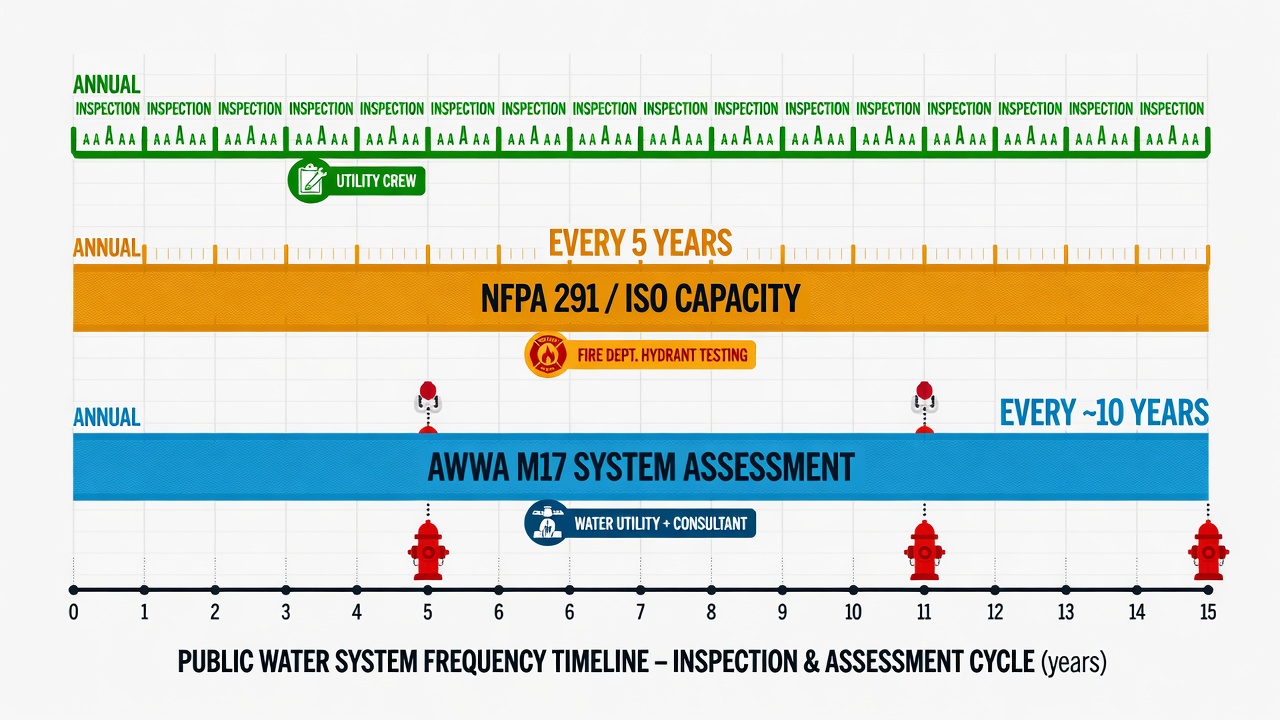
Once ownership lands on the public side, the clocks belong to the water utility or fire department—not the private property owner. Capacity testing, hydrant marking, and system-condition assessment sit on multi-year intervals; basic inspection stays annual. The three documents most often cited for that public map—NFPA 291, AWWA M17, and ISO credit rules—overlap on the need for measured fire-flow data, but they do not share one identical deadline.
NFPA 291’s five-year capacity recommendation
NFPA 291 (2022) states that public fire hydrants should be flow tested every 5 years to verify capacity and marking of the hydrant. That is the figure most often repeated when people ask how often a public hydrant needs a full static–residual–pitot test. The same body of guidance pairs that capacity work with inspection at least annually—opening the hydrant, checking for damage or obstruction, and confirming it operates—so the five-year number never stands alone as the only maintenance rhythm.
Annex language to 4.15.1 softens any reading that treats five years as a hard mandate on every single barrel. It clarifies that the recommendation does not mean to mandate routine five-year testing of every hydrant—especially if there is no pressing need to test a specific hydrant or if test data less than five years old is available from an adjacent hydrant on the same grid. Utilities can therefore plan grid-based sampling rather than an absolute one-by-one countdown when recent adjacent results still describe available fire flow.
AWWA M17’s longer condition-assessment horizon
AWWA M17 approaches flow testing as system condition assessment rather than a hydrant-by-hydrant capacity stamp. It is good practice to conduct flow tests on all parts of the distribution system approximately every 10 years, or whenever needed after significant changes—main replacements, large developments, pump or storage modifications. That decade-scale cycle is deliberately broader than NFPA 291’s capacity-and-marking interval.
ISO’s five-year credit expectation
ISO Public Protection Classification scoring is stricter on the calendar. Fire-flow tests should be conducted on all parts of the distribution system every 5 years to gain full credit for fire-flow testing. Single-hydrant shortcuts usually fall short of what ISO accepts for accurate supply determination, which reinforces the residual-plus-flow setup already required for meaningful results.
Reconciling the clocks without collapsing them
A practical utility program can run a five-year capacity and marking cycle that satisfies both NFPA 291’s recommendation and ISO full-credit expectations, while still using AWWA M17’s ten-year lens for deeper condition assessment and for retesting after major system changes. Annual inspection and operational flushing keep the inventory ready between capacity campaigns. Document results, update color-coding per NFPA 291 after each capacity test, and retain records so the next ISO evaluation or AHJ review has a clean trail. None of these intervals replace local code, IFC adoptions, or AHJ amendments—always confirm what the jurisdiction actually enforces before locking the schedule.
Private Hydrants Under NFPA 25: Annual Operation vs. Five-Year Capacity
On private property the rulebook changes hands, but the same two clocks still apply—and collapsing them into one “flow test every five years” is how sites quietly fall out of compliance. Under NFPA 25 Chapter 7, the property owner owns the ITM program for on-site hydrants. That program stacks frequent functional work against less frequent measured capacity tests; neither interval replaces the other.
Annual work is inspection and full operation. The hydrant is opened fully, lubricated as needed, nozzles checked, and flowed long enough—not less than one minute—to clear foreign material from the barrel and confirm the valve seats. That flush proves the hydrant will work when a company opens it. It does not produce static, residual, or pitot readings, and it does not refresh available-fire-flow figures or color-code markings used for apparatus positioning.
Full capacity measurement sits on the longer clock. Field practice under the NFPA 25 Chapter 7 tables requires a Pitot-gauge flow test that records available gpm every five years. That is the test that documents what the private main can deliver, supports marking updates, and feeds sprinkler or fire-flow calculations. Annual operation keeps the hydrant serviceable; the five-year pitot test keeps the supply data current.
- Annual (operational ITM): visual inspection, full open-and-flow, lubrication, and nozzle checks—flush long enough to clear debris
- Every 5 years (capacity): Pitot-gauge measurement of available flow (gpm) per NFPA 25 Chapter 7
Responsibility never shifts to the municipality just because public hydrants sit on the same grid. The owner still schedules qualified contractors, coordinates water-purveyor permissions or temporary shutoffs, and retains inspection and test records for the AHJ and insurer. Nearby public results do not satisfy private Chapter 7 ITM. Lock the two clocks separately, document both, and the private program stays defensible when the next inspector or underwriter asks for proof.
When to Test Sooner: System Changes, Design Needs, and Local Triggers
Even after those two clocks are locked, the calendar itself can reset. Capacity data ages the moment the system behind it changes. After significant water-main improvements or large developments, waiting out a routine five-year interval leaves emergency response and design teams working from obsolete capability numbers. In those cases the five-year rule does not apply—fire-flow testing should still be completed so the distribution system’s current capacity is known.
Project timelines create the same pressure. New or modified fire-protection designs—sprinkler layouts, standpipe sizing, pump selection—often need current static, residual, and pitot results on a schedule shorter than any standard cycle. Designers and owners should commission a capacity test against the project calendar rather than hope the last municipal or private run is still valid. Always coordinate with the water purveyor so the test method, hydrant selection, and residual locations match how the supply will actually be used.
Local codes, state rules, and AHJ amendments can tighten intervals further, dictate documentation formats, or define which hydrants count toward compliance. Before locking any site schedule, verify the adopted edition of NFPA 25 or NFPA 291, any IFC amendments, and utility or fire-department bulletins that apply to that address.
Test sooner if…
Utilities and private owners can paste a short trigger list into SOPs so field teams know when to break the routine cycle:
- Significant water-main improvements, replacements, or extensions have been placed in service
- A large development or major demand change has been completed in the same pressure zone
- Fire-protection design or remodel work needs current available-fire-flow data
- Known system changes (pump station, tank, PRV, or interconnection) alter supply characteristics
- The AHJ, insurer, or water purveyor requests updated results outside the normal interval
- Prior capacity markings no longer match observed pressures or flow behavior
Treat every trigger as a full capacity test opportunity—static, residual, and pitot—not merely an operational flush. Update color-coding and records immediately so the next inspector, underwriter, or incident commander is working from current numbers.
Build One Defensible Testing Calendar Across Every Standard
With ownership sorted, the two test types separated, and early-reset triggers written into your SOP, the remaining work is mechanical: put every hydrant on a single calendar that an auditor, underwriter, or AHJ can defend. Frequency compliance alone is not enough—if the wrong method is used or authorization is missing, the entry does not count.
Classify, attach standards, then load the clocks
Work hydrant by hydrant. First label each unit public or private. Next attach the rule set that ownership selects. Only then drop annual operational tasks and multi-year capacity tasks onto one shared schedule so nothing is double-booked and nothing is skipped.
- Classify — public utility/fire-department asset versus private on-site hydrant under the property owner’s ITM program.
- Attach standards — public: NFPA 291 capacity/marking intent, ISO system-wide fire-flow coverage, AWWA condition-assessment horizon, plus at least annual inspection; private: NFPA 25 Chapter 7 annual operation and five-year measured flow.
- Load the calendar — annual open-and-flow (function/flush) on one track; full static/residual/pitot capacity tests on the multi-year track; mark any AHJ or post-change acceleration explicitly.
- Coordinate before flowing — water purveyor and AHJ notification, traffic control, and approved test method locked in before the first cap comes off.
- Close the record — dates, personnel, deficiencies, measured data where required, and immediate color-code/marking updates when capacity class changes.
Public programs: one system, several clocks, no wasted tests
A utility or fire-department program can satisfy ISO’s expectation of fire-flow tests across all parts of the system on a five-year cycle, honor NFPA 291’s capacity-and-marking intent (including use of recent adjacent same-grid data where the annex allows), and still run AWWA-style condition assessment on a longer horizon after major changes—without opening every barrel every year for every purpose. Annual inspections and operational checks stay on their own line; full residual-plus-flow setups are reserved for the capacity window or a documented trigger. The calendar shows coverage by zone or grid, not a meaningless list of duplicate single-hydrant shots.
Private programs: owner-led annual operation plus five-year capacity
On private property the owner (or the owner’s designated ITM provider) owns both clocks: annual visual inspection, full open-and-flow for at least one minute, lubrication, and nozzle checks under NFPA 25, plus a separate five-year pitot-measured capacity test of available supply. Nearby municipal testing does not refresh private markings or discharge the owner’s record duty. Note purveyor coordination on the same calendar—shutoff limits, meter/backflow constraints, and who may operate the street valves—so the annual flush and the five-year capacity test are both authorized and valid when performed.
Records that keep the schedule defensible
A defensible file for each hydrant or test zone includes the test date and type (operational versus capacity), names of personnel, static/residual/pitot readings and calculated flow where a capacity test was required, deficiencies found and corrective actions, and confirmation that color-coding or marking was updated when the capacity class changed. Retain those records so the next inspector, underwriter, or incident commander inherits current numbers—not assumptions. When classification, standards, calendar lines, authorization, and records all line up, “how often” stops being a conflict and becomes a schedule you can stand behind.