
Essential Equipment Guide for Accurate Hydrant Flow Testing: Pitot Gauges, Kits, Diffusers & More

Hydrant flow testing only earns trust when the numbers survive scrutiny—from the engineer sizing mains to the authority having jurisdiction that stamps the report. That trust is not a property of any single gadget; it is the product of how pitot gauges, residual gauges, flow test diffusers, hose arrangements, and (when used) devices such as a Hose Monster work together under field conditions.
Too many equipment lists read like catalogs: a gauge here, a kit there, a diffuser if budget allows. The useful way to specify gear is different. Treat every reading—static pressure, residual pressure, and pitot (or equivalent discharge) velocity pressure—as a link in one accuracy chain. Choose instruments so each link holds the next: correct range and resolution on the pressure side, a stable and readable pitot or inline measurement on the discharge side, and discharge control that keeps the stream measurable without destroying the street or the data.
This guide walks that chain from first principles through pitot systems, discharge control, pressure-side instruments, scenario-based kit builds, buying criteria, and calibration readiness. The goal is practical: when you open the case on test day, every piece is there for a reason, and every reading you record can be defended.
The Accuracy Chain: Where Equipment Error Enters Every Flow Result
When that case opens, you are not pulling out one “flow tester.” You are assembling a measurement system. The sensing point at the discharge, the gauge that turns force into a number, the device that shapes and steadies the stream, the residual and static instruments on the pressure side, and the way each reading is logged all sit in series. A weak link anywhere in that chain moves straight into the GPM you report—and into how defensible that number is later.
Flow results look simple on the sheet: a few pressures, a tip size, a calculated discharge. Underneath, several independent uncertainties multiply. Tip coefficient is an assumption about how the orifice actually behaves. Pitot placement decides whether you are sampling the true velocity core or a slower edge of the jet. Gauge readability decides how finely you can resolve the pressure you did capture. None of these stays isolated. A coefficient that is slightly off multiplies a tube held a few degrees out of line, which multiplies a dial you can only interpolate to the nearest coarse mark. The arithmetic after the test cannot remove uncertainty that was baked in at the orifice.
Gear-driven errors that show up as “bad data”
Plenty of questionable results start with the kit, not the crew. Common failure modes include:
- Oversized gauge ranges that park expected residual and pitot pressures in the bottom third of the dial, where resolution is poorest
- Sticky or sluggish needles that lag real pressure changes and invite guesswork
- Uncalibrated sensors or gauges that have drifted since the last check
- Thrashing handheld streams that never hold a stable jet long enough for a clean pitot reading
“Accurate equipment,” then, is not the widest dial or the newest digital face. It is instrument capability matched to the pressures and flows on the hydrants you actually test—ranges that put working values in the readable portion of the scale, discharge control that steadies the jet, and sensing hardware that stays traceable. Treat the kit as one accuracy chain and every static, residual, and pitot reading has a clear reason to be trusted.
Pitot Tubes and Gauges: The Sensing Link That Makes Velocity Pressure Trustworthy
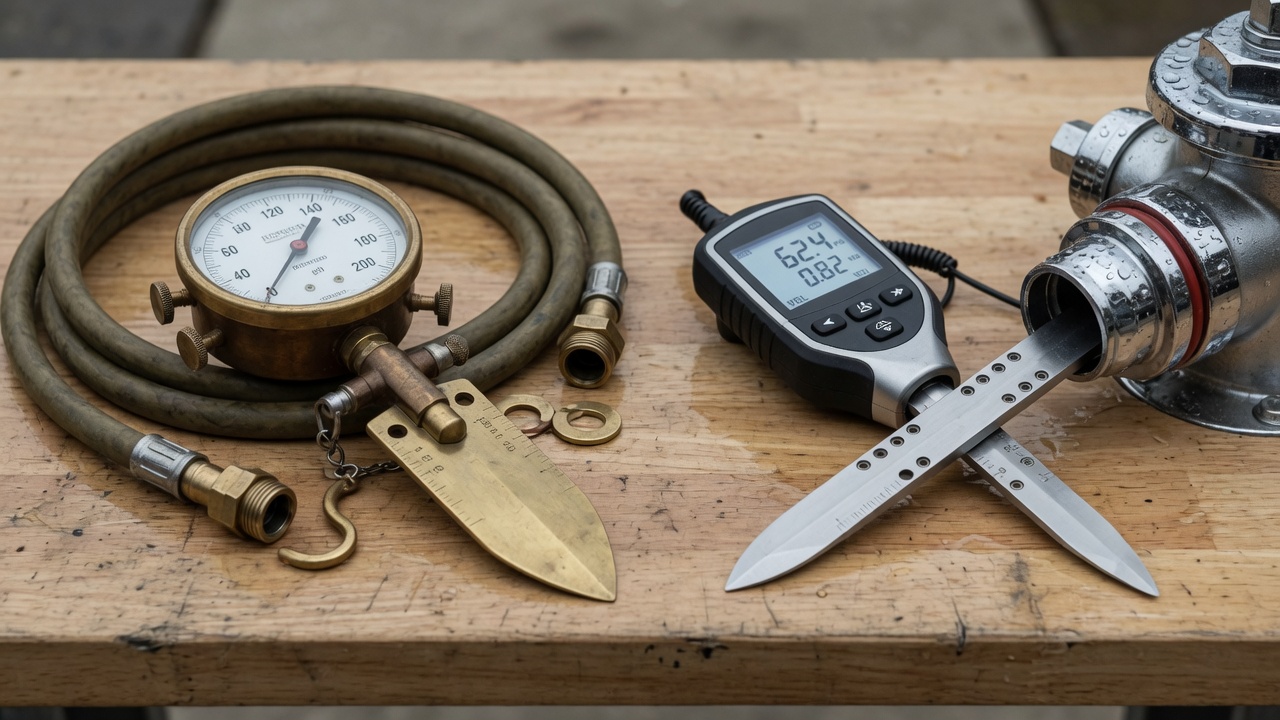
That chain starts at the sensing point—the pitot tube or blade that turns a free discharge jet into a clean velocity-pressure reading. Everything downstream of a sloppy pitot placement is guesswork, no matter how refined the rest of the kit looks. A purpose-built hydrant pitot is short enough to hold steady in one hand, stiff enough that the stream does not whip the tip out of position, and finished with a sharp, protected orifice that sits fully inside the vena contracta. Keep the port square to the flow, centered in the clearest part of the jet, and a few inches clear of the hydrant outlet face so wall effects and spray do not corrupt the reading. Rugged stainless or hardened-brass construction matters here; field use means dropped blades, grit, and the occasional curb strike, and a bent tip immediately changes the coefficient you thought you were using.
Analog pitot gauges: range, damping, and readable needles
The classic analog pitot gauge still earns its place when the crew needs instant visual feedback and minimal electronics. Choose a pressure range that parks typical residual and velocity pressures in the middle third of the dial—too broad a scale and small but meaningful changes become unreadable needle wobble; too narrow and you peg the gauge on a strong hydrant. Liquid-filled cases damp vibration and spray-induced bounce far better than dry movements, especially when the jet is lively. A clear, anti-parallax window and bold graduations let you take the reading without squinting into sun glare or mist. The same gauge body often serves double duty for residual readings on the hydrant barrel, so confirm the connection threads and any snubber or gauge guard are compatible with both roles.
Digital pitot gauges: hold, convert, and capture without losing the plot
A digital pitot gauge earns its keep when the work product is a formal report rather than a clipboard note. Peak-hold freezes the highest stable velocity pressure so the operator can watch the jet instead of the display. Unit conversion (psi to kPa, or direct GPM once the tip size is entered) removes transcription arithmetic. Data capture—whether simple recall or downloadable logs—gives the accuracy chain a paper trail that survives the ride back to the office. The trade-offs are real: batteries fail in cold weather, membranes and ports must stay sealed against continuous spray, and the sensor itself needs the same calibration discipline as any analog movement. In short, digital versus analog pitot gauge choice is less about novelty and more about whether the crew’s reporting and environment justify the extra failure modes.
| Decision factor | Analog pitot gauge | Digital pitot gauge |
|---|---|---|
| Training level | Immediate visual read; minimal setup | Requires menu familiarity and battery checks |
| Reporting needs | Manual log; easy field sketch | Peak-hold, unit conversion, downloadable records |
| Budget & spares | Lower entry cost; simple to stock backups | Higher unit cost; sensor and battery spares |
| Harsh / wet environments | Liquid-filled case shrugs off spray and vibration | Needs sealed ports and cold-rated power |
| Calibration path | Dead-weight or comparator on the Bourdon tube | Same pressure standard plus electronics verification |
Match the instrument to the crew and the deliverable, not to a catalog photo. A well-maintained analog pitot gauge in the hands of an experienced tester still produces defensible numbers; a digital pitot gauge shines when multiple tips, automatic calculations, and auditable logs are part of every job. Either way, the tube geometry, the gauge’s usable range, and a disciplined placement technique remain the non-negotiable front end of the accuracy chain. Once the velocity pressure is cleanly captured, the next link—how that jet is controlled and diffused—determines whether the reading stays steady long enough to trust.
Diffusers and Hose Monsters: Discharge Control That Keeps Pitot Readings Steady
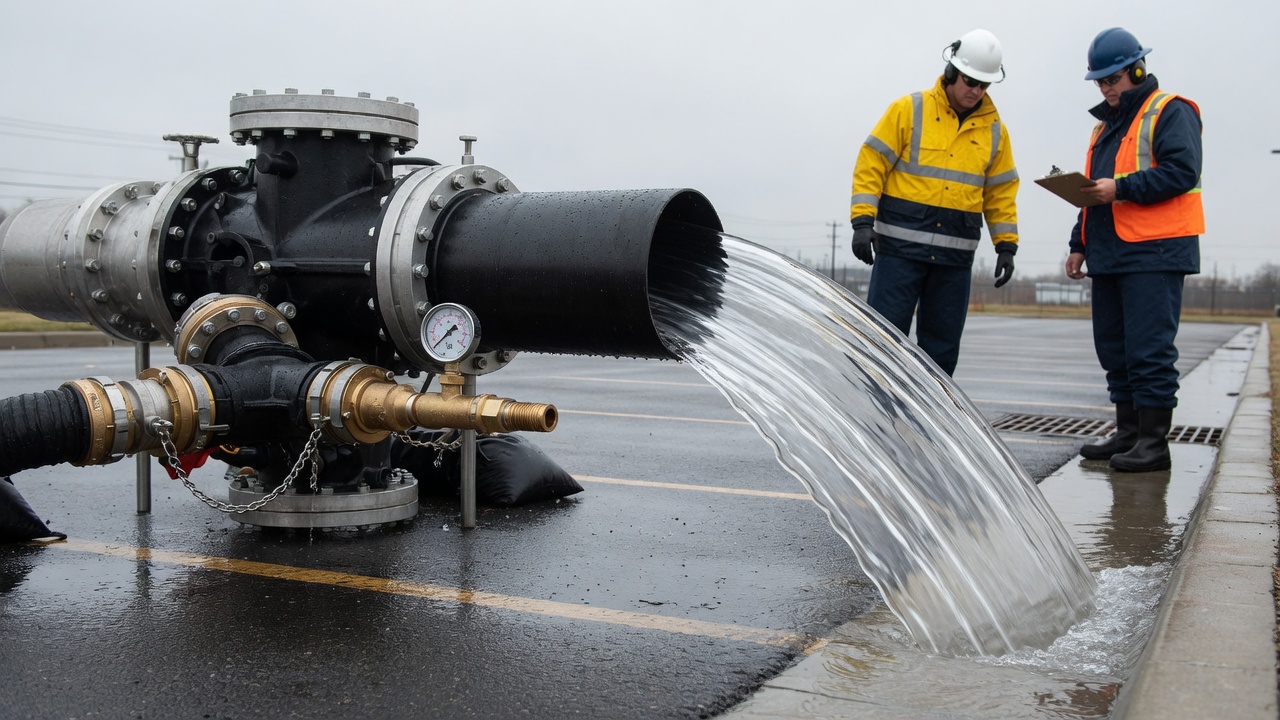
Once velocity pressure is cleanly sensed, discharge control decides whether that reading holds long enough to record with confidence. Diffusers and Hose Monster-class units take the open hydrant stream and manage its energy—baffling turbulence, directing water where it will do least harm, and giving the pitot a stable column of flow instead of a thrashing jet. Treat them as core links in the accuracy chain, not luxury add-ons. Without controlled discharge, even a well-chosen pitot gauge fights inconsistent placement, hose whip, and unsafe spray that undermine every GPM figure you report.
Handheld free streams versus diffuser setups
In a pure handheld setup, one crew member aims a pitot blade into a free discharge while others wrestle hose movement and keep traffic clear. Stream control is limited, pitot angle drifts from moment to moment, and uncontrolled spray risks finished landscaping, storefronts, and roadway flooding. Diffuser and Hose Monster-style equipment reverse that picture. The device mounts to the hydrant outlet or a short lead hose, dissipates the jet through a baffled body, and often includes a dedicated pitot port or integral gauge so the sensing point stays fixed relative to the orifice. Readings settle faster, one or two people can run the discharge side, and water is steered into the gutter or a defined path rather than across sidewalks and plantings.
That difference shows up most clearly in four practical dimensions: stream control (directed and energy-dissipated versus free and whippy), pitot consistency (locked port geometry versus repeated handheld placement), property protection (low-impact discharge path versus spray and scour), and crew size (compact team versus extra hands simply to hold things steady). Integrated measurement ports collapse sensing and discharge into one assembly; separate handheld pitot technique remains workable on low-flow or tight-access hydrants when the crew is practiced and the site allows a safe free stream—but it places heavier burden on technique, coordination, and site control.
Matching discharge gear to the site
Selection is about tradeoffs matched to real conditions, not a single universal unit. On urban streets, compact diffusers that keep flow low and directed protect traffic lanes and cut flooding complaints. Where landscaping is sensitive, favor designs that break velocity before water hits soil or turf. Cold-weather work rewards equipment that drains cleanly between tests and resists freeze-up in the body and ports. High-flow mains demand rated capacity and robust construction so the diffuser itself does not become the weak link or create unsafe backpressure at the hydrant. Choose the discharge device that keeps the jet steady, the pitot location repeatable, and the surrounding property unharmed—then the velocity pressure you captured upstream stays trustworthy all the way into the calculated flow.
Static and Residual Gauges: Locking Down Pressures on the Test Hydrant
Even with a rock-solid discharge setup, the flow numbers only hold if the pressures on the test hydrant itself are just as trustworthy. The pitot story lives entirely on the flowing outlet; static and residual instruments live on a separate outlet of the hydrant under test. That split is deliberate. Static pressure is taken with every outlet closed. Residual pressure is taken on the same hydrant while another outlet is flowing. Confusing the two sides—or treating residual gear as an afterthought—breaks the accuracy chain before any GPM is calculated.
Reliable residual work starts with the hardware that actually seals to the hydrant. Specify gauge assemblies with adapters and caps matched to the common outlet threads in your system—NST, Storz, or the local specialty—so the connection holds without weeping or sudden blow-off under pressure. A liquid-filled or well-damped gauge, mounted so the crew can read it without standing in the spray path, keeps the needle stable while the flow side is opened. Choose the range so the residual reading sits mid-scale on the dial, not pinned near zero on an oversized gauge or jammed against the stop on one that is too small. Mid-scale is where resolution and mechanical reliability are highest; edge-of-scale readings are where small errors become large uncertainties in available fire flow.
Treat the supporting pieces as part of measurement integrity, not a miscellaneous kit list. Carry a spare calibrated gauge, fresh gaskets and O-rings, and a second instrument that can be swapped in for a quick sanity check when the residual drop looks unexpected or when the test will support critical design or acceptance decisions. Those spares keep a sticky needle, a damaged face, or a questionable seal from invalidating an entire set of readings. When adapters seal cleanly, ranges put the needle where it belongs, and a backup instrument is ready, the static and residual values stay traceable to the same accuracy chain that already locked down the pitot side—so every number that enters the flow calculation can be defended.
Build the Kit Around the Job: Utility, Design Data, and Acceptance Testing
That same accuracy chain is what you actually purchase when you put a kit together. The useful conversation is not which catalog bundle looks complete, but who will run the test and what decision the static, residual, and pitot numbers have to support. Rebuild the kit around the job, then add only the modules that job requires—so you neither under-buy the sensing path nor fill the truck with gear that never leaves the case.
Utility-focused kit
Utility crews need discharge control that survives curb lines, traffic, and weather, not lab elegance. Durable diffuser options (or Hose Monster-class units) keep the pitot geometry fixed while directing flow away from landscaping and storefronts. Simple analog gauges with clear, liquid-damped faces stay readable in sun, rain, and night work when a digital screen is harder to glance at under a hood. Dechlorination and discharge rules belong in the same conversation at a high level: if residual chlorine cannot go to the storm system, the discharge device must support treatment or capture without forcing the pitot off its sensing point or turning a two-person job into a hose-wrangling exercise.
Design-data kit
Design and capacity work asks for tighter gauge discipline on both ends of the test. Mid-scale ranges on the residual instrument and the pitot path reduce reading error when small pressure differences drive large GPM swings. Digital logging—peak-hold, steady capture, and clean export—appeals here because the numbers often feed models, reports, and long-term records rather than a single pass/fail call. Two-hydrant readiness matters: residual gear staged on the test hydrant and a stable pitot path on the flow hydrant so the crew can hold residual while flow is measured. The kit supports that setup; it does not need to narrate the full procedure.
Acceptance and retest kit
Acceptance, warranty, and retest work live or die on defensibility. Calibration paperwork travels with every gauge; spare gauges and gaskets sit in the case so a sticky needle or bad seal does not scrap the visit; photo-friendly faces—clear analog dials or stable digital displays—make field photos usable when an inspector or owner’s engineer reviews the file. Multi-site crews need transport cases that keep adapters, pitot tubes, and instruments from rattling loose between hydrants so the accuracy chain that left the shop is still intact at the last stop.
Shared core, modular add-ons
Across all three scenarios, buy a shared core first, then bolt on only what the job demands:
- Pitot tube or blade paired with a readable analog or digital gauge
- Static/residual gauge set with thread-matched hydrant adapters and caps
- Diffuser or Hose Monster-class discharge device with fixed or ported pitot sensing
- Spare gaskets, one backup gauge, and basic hand tools
- Documentation sleeve for calibration stickers or certificates
Modular add-ons then follow the scenario—dechlorination accessories for utility discharge rules, data-logging pitot and a second residual path for design surveys, hard cases and photo-ready spares for acceptance crews. Spec the core for traceability; add modules for the decision the numbers must support. That is how kit builds stay honest instead of over- or under-equipped.
Spec and Buy Criteria That Protect Measurement Integrity
That honesty in kit building only holds if every purchased piece can defend its place in the accuracy chain. Translate the job into a short specification before you compare catalogs: match gauge pressure ranges to the statics and residuals you actually see so needles or digits sit mid-scale; require an accuracy class tight enough for the decisions the numbers will support; confirm pitot blades or tubes mate cleanly with your chosen diffuser ports or free-stream technique; insist on a case that survives truck floors and wet pavement; list the spare gaskets, caps, and secondary gauges that keep a single failure from ending the day; and demand clear calibration support—certificates, intervals, and a path back to the lab—so every reading stays traceable.
Buyer questions that separate kits from loose parts
Searches for the “best hydrant flow test kit” often hide what is included versus sold separately. Ask directly: Does the package contain the pitot, static/residual gauge set, adapters, and diffuser, or will those arrive as line items later? What continuous flow rating and outlet control does the diffuser or Hose Monster-class device carry? Can gauges be replaced in the field without sending the whole assembly back? What warranty covers spray, vibration, and drop damage? How steep is the training curve for crews who already know analog pitots but may be new to digital peak-hold or integrated ports? Answers to those questions keep facility managers and AHJ-adjacent reviewers from approving a box that still needs half a truck of add-ons.
Lifecycle cost, not just sticker price
Factor the costs that arrive after the purchase order. Recalibration intervals, battery or sensor replacements on digital units, damaged pitot blades, and the downtime when a sticky or fogged gauge fails mid-test all erode any bargain. A low-cost gauge that cannot hold calibration or survive repeated spray and vibration is not a savings—it is a break in the accuracy chain. Specifier language should therefore treat durable construction, serviceable parts, and documented support as integrity requirements, not optional upgrades. When the specification names ranges, accuracy class, compatibility, case quality, spares, and calibration path up front, the kit you receive can be defended the same way the flow results must be.
Calibration, Care, and Pre-Test Checks That Keep Results Defensible
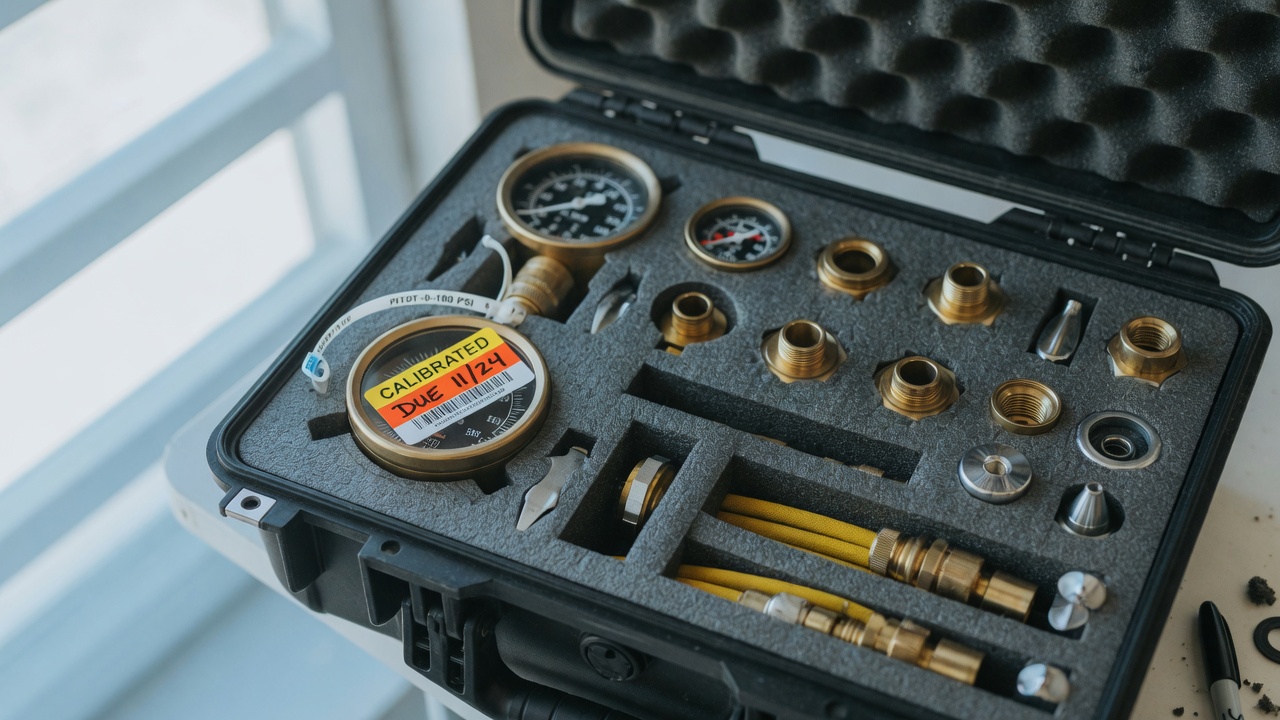
That same discipline has to follow the kit into the field and through its working life. A gauge that left the factory within accuracy class only stays defensible if calibration is current, documentation is on hand, and the instrument has not been abused between tests. Buy-right and kit-by-scenario decisions close only half the loop; the other half is keeping every static, residual, and pitot reading traceable when someone later questions the numbers.
Calibration intervals and documentation for official records
Gauges that support official flow records should carry current calibration documentation—not a one-time factory sticker and not a vague promise that “it still looks right.” Utilities, design firms, and acceptance programs typically set a regular interval for pitot and residual instruments, require certificates that identify the gauge and the standard used, and expect that paperwork to travel with the kit or sit in a retrievable file. The point is not laboratory theater; it is so any static, residual, or velocity-pressure reading in a report can be tied back to an instrument whose accuracy was verified before the test day. When an AHJ, engineer, or opposing party asks how you know the gauge was good, the answer is a dated certificate and a matching serial number—not crew memory.
Field care that protects the sensing chain
Between calibrations, ordinary abuse is what breaks the accuracy chain. Freeze damage warps bourdon tubes and digital sensors left wet in cold truck boxes. Clogged pitot ports and kinked sensing tubes distort velocity pressure long before the needle looks wrong. Overpressure—slamming a low-range residual gauge onto a high static main, or trapping surge in a closed cap—can shift zero or ruin the movement. Diffuser ports and integrated gauges suffer the same neglect: grit, bent blades, and loose fittings that only show up as scatter in the pitot readings. Storage matters as much as use: instruments tossed loose among wrenches, left soaking in a wet compartment, or stored with open ports collect the damage that later appears as disputed GPM.
Pre-test readiness checklist before the crew leaves the shop
A short shop check catches most of that damage before it becomes a bad test:
- Confirm calibration status and that certificates match the gauges in the case
- Zero-check analogs and digitals at atmospheric pressure; reject sticky, bent, or off-zero needles
- Verify faces are legible and liquid-filled cases are full, not fogged or empty
- Inspect pitot blade or tube tip for dents, clogs, and free sensing path
- Check adapter and cap gaskets for cuts, flat spots, and correct thread match
- Walk the diffuser or Hose Monster-class device for cracks, secure ports, and directed discharge path
- Confirm digital battery status, peak-hold function, and dry connectors
- Restock spare gaskets, a backup gauge, and any job-specific adapters before departure
Skip that list and the failure modes are predictable: residual that will not settle, pitot scatter that no coefficient can fix, and flow figures that cannot be defended when a main extension, fire-flow credit, or acceptance test is challenged. Poor maintenance does not merely inconvenience the crew—it turns an otherwise sound accuracy chain into numbers that fail design assumptions and invite retests under harder scrutiny.
The equipment lifecycle for defensible hydrant flow work is therefore one continuous chain: specify durable, serviceable instruments with clear ranges and calibration paths; build the kit around the jobs you actually run; then keep every gauge, pitot, and diffuser trustworthy through documentation, field care, and a readiness check that happens before the truck rolls. When sensing, discharge control, and residual measurement are treated that way end to end, static, residual, and pitot readings stay traceable and repeatable—and the flow results can stand up to the same standard you wrote into the purchase.