
NFPA 291 Fire Hydrant Color Coding and Marking Guide: What the Colors Mean for Flow Capacity
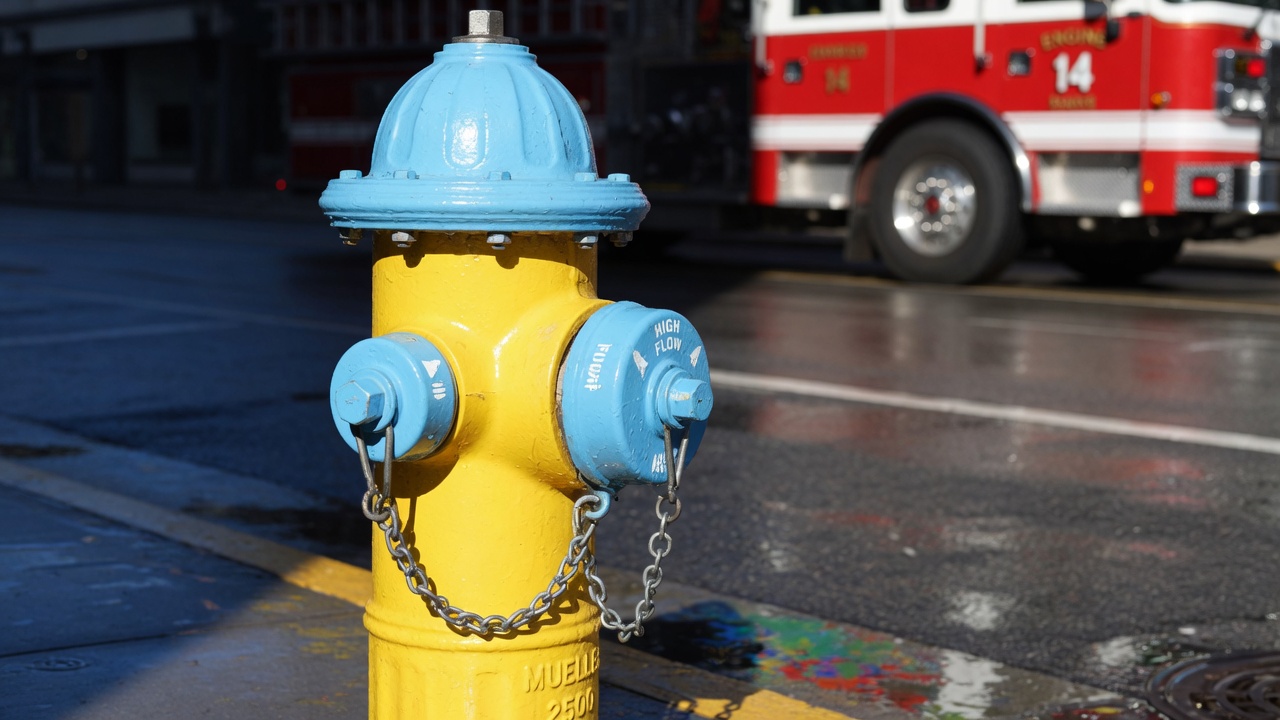
Why Capacity Colors Are the Last Mile of Every Flow Test
For companies responding on mutual aid or reviewing system performance, those colors only help if they faithfully report calculated available flow—not the raw numbers from the test day. That final translation from data to paint is exactly what NFPA 291 exists to guide.
NFPA 291 is the nationally recognized recommended practice for fire flow testing and marking of hydrants. It establishes the procedures for measuring static, residual, and flow pressures, calculating available fire flow, and then marking hydrants according to the water delivery capacity those calculations produce. It is not a field manual on how to set up a pitot gauge or which diffuser to buy. Its job is to close the loop between the numbers you collect and the visible marks crews will actually use.
Once the bonnet and caps carry the right class color, they become a rapid capacity cue. Apparatus drivers can decide placement and supply strategy before the first line is laid. Mutual-aid companies unfamiliar with the local grid can read residual strength at a glance instead of guessing or waiting for a radio update. Over successive retests, a consistent color map also surfaces chronic low-capacity zones that need capital attention and feeds the documentation insurers and ISO evaluators expect when they score a community’s water supply.
This guide therefore stays on the classification and marking decisions that turn a completed flow test into trustworthy colors. Pure test-procedure steps and equipment comparisons live elsewhere. Here the question is simpler and more operational: once you hold the calculated available flow at 20 psi residual, how do you paint so the next engine company reads capacity correctly the first time?
Reading Capacity at a Glance: NFPA 291’s Four Bonnet and Cap Classes
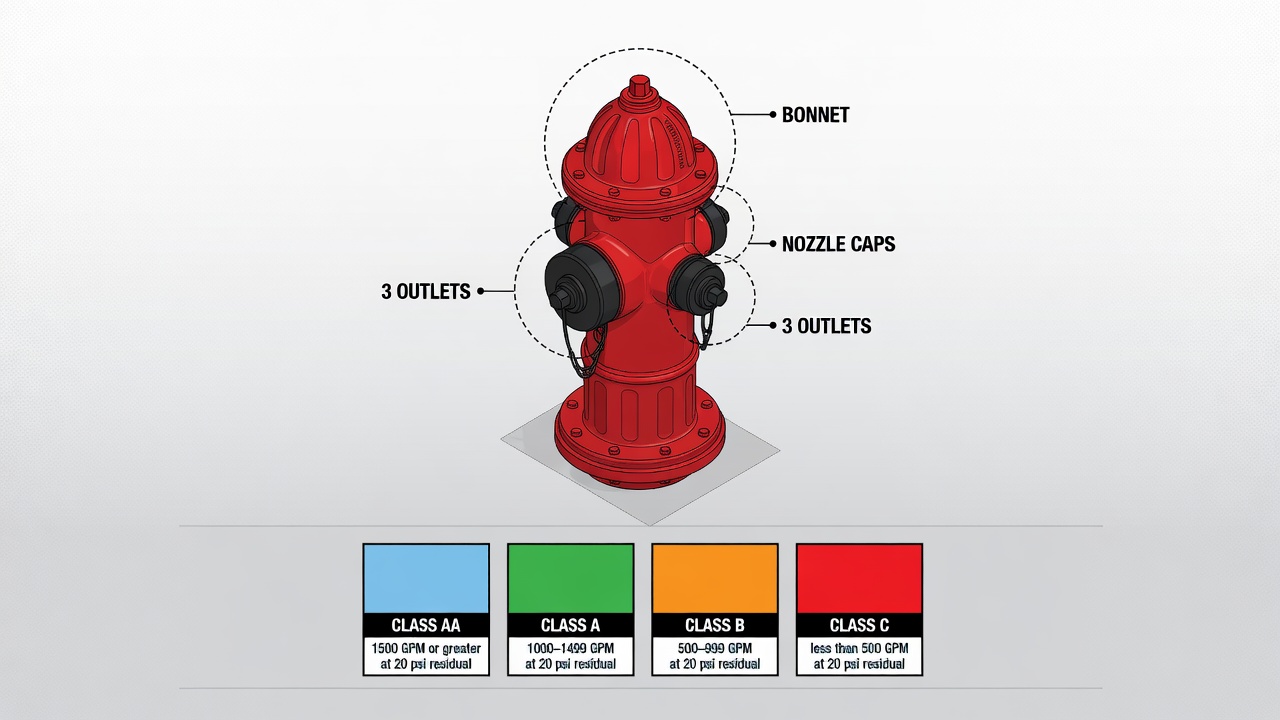
That calculated available flow at 20 psi residual is what NFPA 291 turns into a paint schedule. Table 5.1 of the recommended practice assigns every tested hydrant to one of four rated-capacity classes and specifies the colors that go on the bonnet and the caps—the parts crews actually see first. Barrel color is a separate signal (public versus private, potable versus non-potable); capacity lives only on the top and outlets so the class stays readable from the street, the sidewalk, or the opposite curb.
The four classes and their NFPA 291 Table 5.1 coding are straightforward:
| Class | Rated capacity at 20 psi residual | Bonnet & cap color |
|---|---|---|
| AA | 1,500 gpm or greater | Light blue |
| A | 1,000–1,499 gpm | Green |
| B | 500–999 gpm | Orange |
| C | Less than 500 gpm | Red |
What each class means on the fireground
Light-blue Class AA hydrants are the high-volume supply points. They can feed multiple large lines, master streams, or a supply operation that keeps several companies working without immediate tanker or additional-hydrant support. Green Class A hydrants still deliver strong urban or suburban flow—enough for a solid initial attack and a secondary line—while leaving a useful residual for the next-arriving engine.
Orange Class B marks moderate capacity: typically enough for one or two handlines on a residential or light-commercial fire, but crews should plan early for additional water sources if the incident grows. Red Class C signals limited single-line support. These hydrants may still be valuable for exposure protection or a defensive stand, yet they will not sustain a prolonged interior attack by themselves. Painting both bonnet and caps the same class color keeps that message consistent no matter which side of the hydrant the apparatus stops on.
Because the colors encode only the calculated available flow at 20 psi residual—not the raw pitot reading from the test—the marking stays honest under real operating pressure. Get the class right from that residual-basis figure, and the next engine company can place apparatus and call for water with confidence the first time it rolls up.
From Test Numbers to Bonnet Color: Classifying at the Correct Residual
That honesty depends on one disciplined step after the gauges come off: converting the field readings into rated capacity on NFPA 291’s residual basis before any paint touches the bonnet or caps. The colors are never a snapshot of the unadjusted flow observed during the test. They represent calculated available fire flow at the residual pressure the standard requires—so the mark stays true when the system is actually under fire demand.
The residual basis NFPA 291 requires
NFPA 291 ties every class decision to residual pressure, not to the raw pitot or meter reading alone. When static pressure is above 40 psi, rate the hydrant’s available fire flow at a 20 psi residual. When static pressure falls below 40 psi, drop the rating basis to half the static value. Those two rules keep the classification comparable across the system and prevent a high-static hydrant from being painted the same color as one that will collapse under real load.
Skipping that reduction is the dominant marking error. Leaving the color tied to the flow observed at whatever residual the test happened to produce—instead of calculating available flow down to the required residual—can change the color class on up to 50 percent of hydrants. A hydrant that looked like a solid Class A during the open-butt test can drop into Class B or C once the numbers are brought to 20 psi (or to half-static). Paint applied before that math is finished simply freezes the mistake in place.
A clean path from data to paint
Keep the sequence short and non-negotiable so crews and water-system staff reach the same class every time:
- Gather the static pressure, residual pressure, and measured flow results from a proper hydrant flow test.
- Compute rated capacity on the correct residual basis—20 psi when static is above 40 psi, or half the static value when static is below 40 psi.
- Select Class AA, A, B, or C from that calculated figure alone.
- Only after the class is locked in, paint the bonnet and caps with the matching capacity color (and use reflective-type paint so the signal works at night).
When a hydrant’s available flow must be rated at a residual lower than 20 psi, do not imply a full 20 psi class with color alone. Stencil the actual rated capacity and the residual pressure used so the next company knows the limitation at a glance. That single extra mark prevents the color code from over-promising water that the system cannot deliver under fire conditions.
Barrel Colors: Ownership and Water Source at a Glance
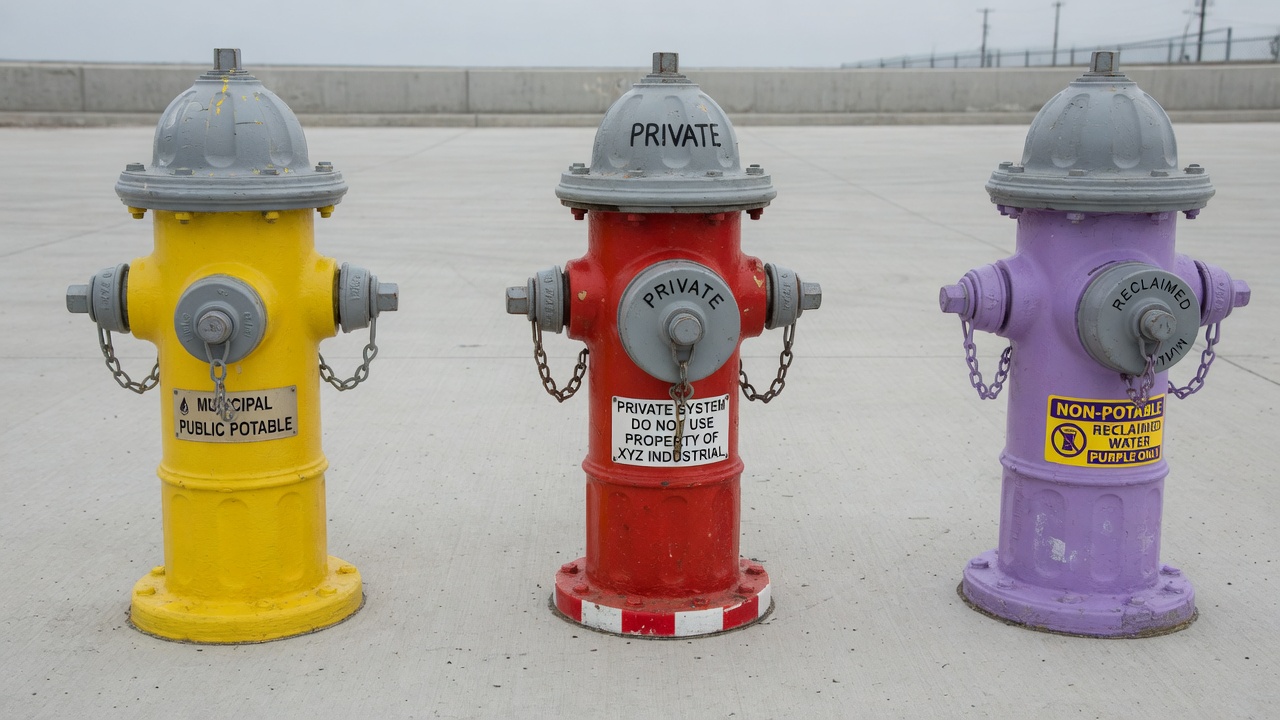
Capacity marks on the bonnet and caps answer how much water the hydrant can deliver at the rated residual. The barrel answers a different pair of questions—who owns it and what kind of water it supplies—and NFPA 291 keeps those signals deliberately separate so crews never confuse ownership with flow class.
For public or municipal systems, barrels should be chrome yellow unless the jurisdiction has already adopted another high-visibility color. That bright yellow is the default cue that the hydrant sits on the public water system and is available under normal municipal control. Consistency here matters for mutual aid: when every city hydrant reads the same way, visiting companies do not waste time second-guessing the asset.
Private hydrants located on public streets should be painted red or another distinguishing color from the public ones. The contrast tells arriving companies that the asset is privately controlled—useful when access, maintenance responsibility, or authorization differs from the city system. Painting a private barrel the same yellow as a municipal hydrant erases that ownership signal and can slow decisions when the private system has different pressure, valving, or use rules.
Hydrants supplied by non-potable sources get violet (light purple) barrels. That distinction matters on the fireground: drafting or connecting from a non-potable line can introduce contamination risks to potable systems if cross-connections are mishandled, and it flags that the water may not be suitable for every tactical use without additional precautions. Violet is not a capacity color—it is a source warning that stands apart from the bonnet and cap scheme.
The two-second field read
Train the eye to split the hydrant in half: the barrel answers “whose water / what source?”; the bonnet and caps answer “how much at rated residual?” Chrome yellow (or the local high-visibility public color), red for private on public streets, and violet for non-potable cover the ownership and source side. Light blue, green, orange, and red on the top still carry only the Class AA through C capacity story established earlier. Keep the two coding systems cleanly separated and the hydrant becomes a reliable, at-a-glance briefing instead of a mixed message.
Making the Marks Stick: Reflective Paint, Stencils, and Out-of-Service Rules
Those capacity colors only help if they stay readable when the call comes after dark or the hydrant is half-obscured by weather and roadside clutter. Field marking is therefore part of the classification system itself: the same residual-based class that chose light blue, green, orange, or red must be finished and annotated so crews can trust what they see.
Reflective paint on bonnets and caps
NFPA recommends using reflective-type paint for the capacity colors on bonnets and caps so Class AA through C can be identified easily at night. Ordinary enamel may look correct in daylight and still disappear under headlights or scene lighting; a reflective finish keeps the residual-based class visible when apparatus is still rolling up. Apply it only to the capacity surfaces—the tops—so the barrel’s ownership or source color stays a separate, non-reflective cue.
Stencils that prevent over-reading a class
Color alone is enough for most hydrants, but two cases need numbers. High-volume hydrants can have their rated capacity stenciled on the top so the exact gpm at the rated residual is visible without a second look-up. Hydrants rated at less than 20 psi should have that rated pressure stenciled in black on the top. The black figure stops anyone from treating a pressure-limited asset as if it carried a full 20 psi class—exactly the misread the residual method was designed to prevent.
Out-of-service indication versus permanent removal
A painted class is a promise of available flow. Temporarily inoperative hydrants should be bagged or otherwise clearly indicated so that promise is suspended until the unit is restored. Permanently inoperative hydrants should be removed; leaving dead metal in the street with capacity colors still on it invites crews to plan on water that will never arrive. Local practice may vary on bag style or tagging, but the principle is fixed: colors are never trusted on assets that cannot deliver.
Durability cues that trigger a recoat
Marking work is not a full maintenance program, yet a few field checks keep the residual class honest between tests:
- Fading or chalking that muddies the light-blue / green / orange / red distinction
- Peeling or bare metal on bonnet or caps that breaks night reflectivity
- Illegible or missing black pressure stencils on low-residual hydrants
- Worn capacity numbers on high-volume tops
- Any bag or out-of-service indicator that has fallen off or become ambiguous
When any of those show up, recoat or re-stencil to the current calculated class—do not simply touch up the old shade. That keeps the at-a-glance briefing accurate until the next formal retest cycle takes over.
Keeping Marks Honest: Retests, Local Rules, and Corrections
That next formal retest is what keeps the whole system honest. Public fire hydrants should be flow tested every 5 years to verify both capacity and the marking that communicates it. The interval is not arbitrary: mains age, demands shift, and valves get exercised or neglected, so the calculated available flow at the proper residual can drift enough to change a class. When the new numbers land, bonnets and caps are recoated to the current class—or left alone only if the class is unchanged—so the paint always matches the latest residual-basis result rather than the last coat someone applied.
Local rules sit on top of that cadence. In some jurisdictions, hydrants must be marked or color-coded based on performance in accordance with NFPA 291 or local amendments. Even where the code is silent, aligning with the four-class bonnet scheme still pays off: mutual-aid crews, ISO reviewers, and neighboring departments read the same colors the same way. Consistency across a response area matters more than inventing a unique local palette that outsiders have to decode under pressure.
Correcting legacy colors that were never residual-based
Many systems still carry colors painted from raw test flow. The fix is a short, disciplined workflow rather than a wholesale repaint of every hydrant at once:
- Pull the last test data (or retest) and recalculate available fire flow on the NFPA 291 residual basis—20 psi when static is above 40 psi, or half of static when static is lower.
- Assign the correct class (AA, A, B, or C) from that number and repaint bonnet and caps with reflective-type paint in the matching color; stencil capacity or low residual pressure where the practice calls for it.
- Update the hydrant record and GIS layer so the new class, test date, and residual are what the next crew or engineer will see.
- Flag any system deficiencies the reclass reveals—undersized mains, closed valves, or clusters of Class C hydrants—so operations and capital planning can act on them instead of treating the color change as cosmetic.
Color coding under NFPA 291 is therefore a living compliance control, not a one-time paint job. Every five-year test, every local mandate check, and every correction of a raw-flow legacy mark keeps the at-a-glance signal true. When the bonnet still matches the calculated available flow at rated residual, crews can trust what they see—and the system deficiencies those colors expose stay visible long enough to be fixed.